hDrop Sweat Sensor Tested Outdoors: 51% Overestimation at 27°C
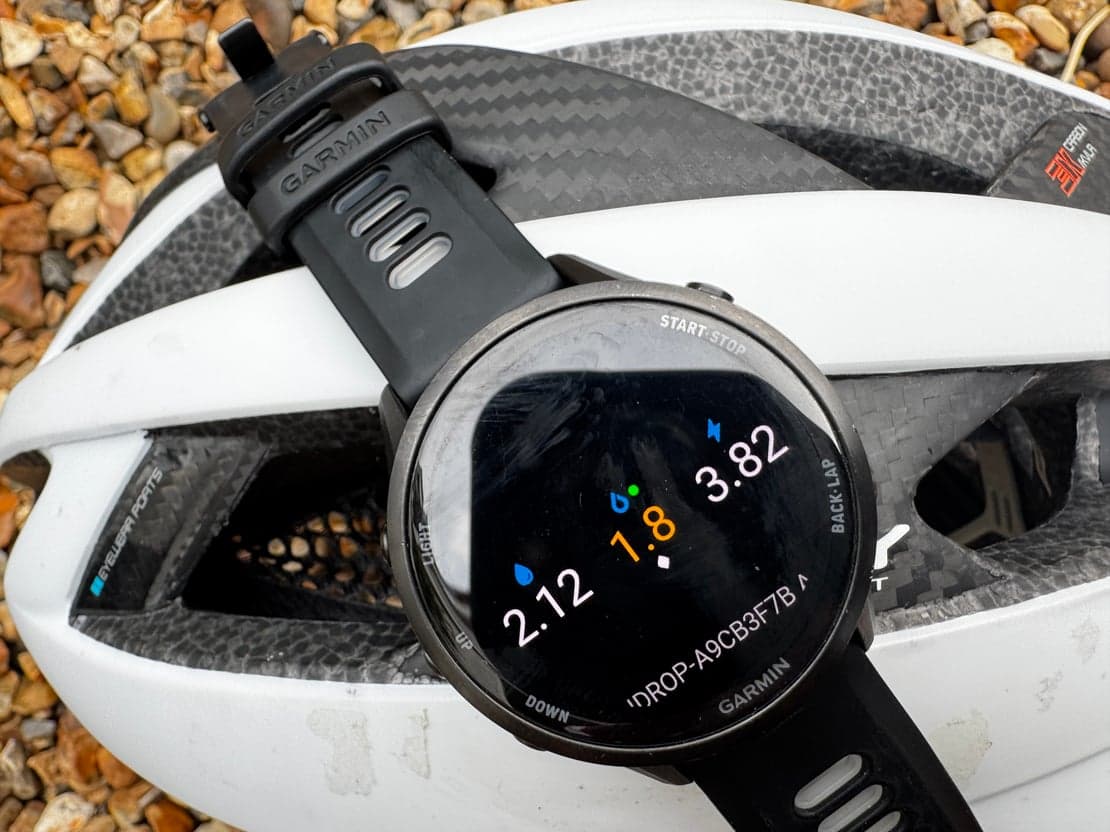
The hDrop sweat sensor promised to solve one of endurance sport's most practical problems: knowing exactly how much fluid you've lost during a workout, in real time, on your wrist. Tested outdoors during a 2x20 cycling effort at 27°C, the device overestimated fluid loss by 51% against body weight change, which is the gold standard field method for measuring sweat loss. That gap is not a rounding error. It's the difference between drinking the right amount and overcorrecting into hyponatremia territory.
How the hDrop Sensor Actually Works
The hDrop uses a skin-contact electrochemical sensor to detect sweat rate and electrolyte concentration, primarily sodium. This is fundamentally different from the PPG optical sensors found on Garmin, Polar, or Coros wrists, which measure blood volume changes through light to estimate heart rate and SpO2. The hDrop is reading the chemistry of your sweat directly off the skin surface, then running an algorithm to estimate total fluid loss over time. The Connect IQ data field integration on the Garmin Forerunner 970 was clean and functional. The data appeared consistently during the ride, no dropouts, no crashes. The software side held up. The sensor physics did not.
At 27°C outdoors, sweat rate increases sharply compared to indoor conditions, and sweat distribution across the body becomes less uniform. The hDrop sits on one location, typically the forearm or wrist area, and extrapolates whole-body fluid loss from that single patch reading. In cool, controlled indoor conditions, that extrapolation is more defensible. In summer heat with variable airflow, evaporative cooling rates differ across body segments, and the algorithm appears to overcorrect. A 51% overestimation means if you actually lost 1.0 kg of fluid during that effort, the hDrop told you 1.51 kg. Acting on that number mid-ride leads to excessive drinking.
Calibration Did Not Fix the Accuracy Problem
The device includes a calibration process intended to personalize sweat rate estimates to the individual athlete. After calibration, the outdoor numbers were still significantly inflated. This suggests the core issue is not individual variation in sweat composition but the environmental model itself. Heat and direct sunlight affect sensor readings in ways calibration offsets cannot fully compensate. Polar and Garmin face the same fundamental challenge with wrist optical PPG in bright sunlight, where photoplethysmography accuracy drops because ambient light interferes with the sensor's ability to isolate the signal from blood volume changes. With the hDrop, the problem is different in mechanism but similar in result: outdoor conditions degrade accuracy in ways the software cannot reliably correct.
For comparison, research-grade sweat analysis patches used in sports science labs are single-use, controlled for temperature, and still carry measurement uncertainty around 10 to 15%. A consumer wearable hitting 51% overestimation at moderate summer temperatures is outside the range where you'd want to make real-time hydration decisions from it. Whoop 5.0 does not measure sweat loss at all, and neither does the Apple Watch Series 11 or the Coros Pace 4. Those devices rely on generic sweat rate models based on HR, power, and ambient temperature. The hDrop's premise, direct electrochemical measurement, is scientifically stronger than those proxy models. The execution in outdoor heat is not there yet.
Real-World Use Case for Athletes
For a triathlete or cyclist doing structured indoor sessions, the hDrop's Connect IQ integration is genuinely useful. The Forerunner 970 displays the data cleanly alongside power, HR from a chest strap's electrical ECG signal, and pace. If your training block is predominantly on the turbo trainer in a temperature-controlled space, the sensor's accuracy window is narrower and more reliable. Outdoor summer racing and training is where it falls apart. A runner doing a hot-weather long run, a triathlete racing an Olympic distance in July, or a Hyrox athlete in an overheated competition hall should not rely on these numbers for in-session hydration decisions. The body weight delta method, weigh before and after, remains the most reliable way to calibrate your personal sweat rate across conditions.
What's missing is an environmental correction model that accounts for ambient temperature, humidity, and solar load dynamically, not just at the point of calibration. The hDrop also lacks sodium concentration accuracy validation in heat, which matters for electrolyte replacement decisions as much as fluid volume does. The price point is not entry-level. Spending that much and getting 51% overestimation outdoors in summer, which is when most endurance athletes actually need hydration data, is a significant limitation that the current firmware has not resolved.
The hDrop is worth watching for indoor-focused athletes or those doing most of their key sessions on a trainer, where the Connect IQ integration with Garmin works well and temperature is controlled. For outdoor summer training, it is not ready to replace the scale. The Garmin Forerunner 970's built-in sweat loss estimates, while less sophisticated, are at least transparent about being algorithmic approximations rather than direct measurements. If you're deep into cycling tech and want to follow related accuracy testing, the [Amazfit Balance 3 cycling and swimming accuracy piece](/en/articles/amazfit-balance-3-cycling-and-swimming-accuracy-tested-real-numbers-2026-07-20) is worth reading alongside this one.
Mentioned watches
Head-to-head comparisons