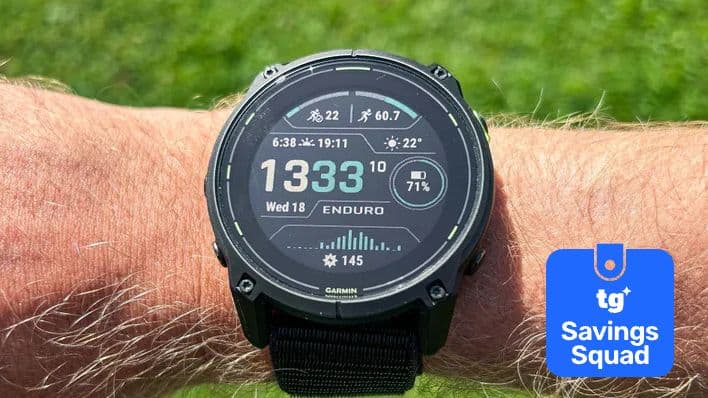
Garmin Fenix 9 Pro Review: Fast, Premium, GPS Caveat
What it is
The Garmin Fenix 9 Pro is Garmin’s no-compromise endurance watch for runners, triathletes, hikers and expedition-minded athletes who want serious navigation and training analysis in a luxury build. It sits at the top of the range, with a titanium case, 64GB of storage, LTE and satellite connectivity, a microphone and speaker, plus a diveproof design. This is firmly premium territory: the 51mm Fenix 9 Pro costs roughly $400 to $500 more than the $789 Enduro 3, putting it in the neighborhood of $1,189 to $1,289 depending on configuration. That is a lot of money for a sports watch, even a very capable one.
Key specs
- GPS/GNSS: Multi-band, multi-constellation GNSS. Garmin uses the same GPS chipset in the Fenix 9 and Fenix 9 Pro, but the precise silicon maker has not been confirmed in the supplied reporting. It can use GPS, GLONASS, Galileo and BeiDou.
- Battery life: Garmin’s exact GPS battery-life figure in hours for the Fenix 9 Pro is not provided in the available sources, so I will not invent one. What is clear is that the lighter MIP-and-solar Garmin Enduro 3 lasts longer than the 51mm Fenix 9 Pro.
- Heart rate, HRV and SpO2: Wrist optical PPG sensor array, shared with the standard Fenix 9. PPG uses LED light to detect blood-volume changes. HRV is derived from beat-to-beat intervals, while SpO2 is an optical estimate of blood-oxygen saturation.
- Skin temperature: No skin-temperature sensor is confirmed in the supplied sources.
- Altimeter: A barometric altimeter is not specifically confirmed in the supplied sources. Do not assume GPS elevation substitutes for it: a barometric altimeter calculates altitude from air pressure.
- Display: AMOLED, rated as high as 3,000 nits on Fenix 9 Pro models. Garmin also keeps MIP screens on Solar versions of the wider Fenix 9 range, but the sources do not establish that as a Fenix 9 Pro configuration.
- Storage: 64GB, enough for offline maps and music without the constant storage management older 32GB Garmin flagships encouraged.
- Weight and water resistance: The supplied sources confirm a titanium case and describe the watch as diveproof, but give no verified gram weight or water-resistance rating. Those numbers should matter to buyers, and their absence from this reporting is frustrating.
On paper, the Pro’s real hardware advantage over the regular Fenix 9 is its titanium case and newer processor. The display is bright enough to solve the usual AMOLED-in-sunlight anxiety, and 64GB is genuinely useful for people who load topo maps before an ultra. The processor also makes the Pro the fastest Garmin in WristBench’s public Connect IQ benchmark. Faster maps, quicker workout saves and smoother interface response are welcome, though they are not a reason by themselves to spend flagship money.
Performance in the real world
The good news is that the Fenix 9 Pro delivered the better race-day GPS result in a difficult Frankfurt Marathon comparison against the Apple Watch Ultra 4. Through rain, crowds, skyscrapers and roughly 18,000 runners, the Garmin recorded 42.76km. The Apple logged 43.33km. The runner’s bib pace was 4:52 min/km; the Fenix showed 4:48 min/km, while the Apple showed 4:44 min/km. Neither track was perfect, but the Garmin was consistently closer. For someone trying to hit marathon pace in a dense city, that is a meaningful win, not spreadsheet trivia.
There is a big asterisk. Real-world testing found the Fenix 9 Pro can drop an entire GNSS constellation during an activity to preserve battery. This behavior is repeatable, but it is not yet clear whether it comes from new GPS silicon or Garmin firmware power management. In open terrain and sessions under 90 minutes, it probably changes very little. In a forest, steep valley or city center, losing one constellation can mean an estimated 5 to 15 meters of positional drift. That is exactly where buyers of a Fenix expect the watch to be at its best. For long events, the concern is more serious: there is no published evidence showing how this behavior affects a 5 to 6-hour Ironman bike leg, or a 20 to 30-hour 100-mile ultra.
Heart-rate evidence is less conclusive. In Frankfurt, the Fenix and Apple Watch Ultra 4 both reported an average of 172 bpm, while an Oura Ring 5 reported 179 bpm. Without a chest strap as the reference, that does not prove either watch was correct. It does tell us that the Pro’s wrist PPG sensor was not the clear differentiator in that test. The Fenix 9 Pro shares its optical sensor hardware with the cheaper Fenix 9, so do not buy Pro expecting improved wrist HR accuracy. For intervals, hill repeats and other abrupt intensity changes, pair a proper chest strap. A chest strap reads the heart’s electrical impulses using the ECG principle, which remains the better reference for effort data than wrist PPG.
Sleep, recovery and health tracking should be familiar Garmin territory rather than a special Pro perk. The same optical system feeds overnight HRV and SpO2 estimates, then supports Garmin’s broader Body Battery, training readiness and load analysis. Garmin’s data ecosystem remains one of the reasons to buy this watch. Connect IQ, structured workouts, maps, Strava and TrainingPeaks workflows are mature, and 64GB gives those maps room to breathe. Garmin’s new Epic activity recording and Stamina tools are useful for multi-day efforts, but many headline software features are also rolling out to older supported Garmin watches. The Pro buys speed and hardware, not exclusive training insight.
One practical advantage over the Apple Watch Ultra 4 is controls. The Fenix was easier to operate in Frankfurt rain because it has more physical buttons. That sounds mundane until you are soaked, wearing gloves or trying to lap a race without stabbing at a wet screen. Conversely, the Enduro 3 is the smarter Garmin alternative for athletes who prioritize low weight and battery endurance over AMOLED, LTE, satellite connectivity and a titanium-heavy flagship build.
Who it’s for / who should skip it
Buy the Fenix 9 Pro if you are a serious endurance athlete who wants offline mapping, Garmin’s deep training platform, a bright 3,000-nit AMOLED screen and standalone connectivity in one extremely rugged watch. It is especially appealing if you race in wet weather or cities and value buttons over a touchscreen-first experience. It also makes sense for someone who wants a premium daily watch that can handle an ultra without looking like a plastic running computer.
Skip it if your top priority is maximum GPS confidence over very long, technical routes. The constellation-shedding behavior is a real concern, and Garmin has not yet provided the long-duration accuracy data that would dismiss it. Skip it too if you already own a Fenix 8 or another current supported Garmin and mainly want new training features, because many are arriving through software updates. Finally, choose the Garmin Enduro 3 if battery life and lower weight matter more than AMOLED, LTE and satellite tools. Choose the Apple Watch Ultra 4 if smart-watch apps and iPhone integration are your main reasons for wearing a watch, but accept that its Frankfurt marathon GPS result was worse.
Verdict
The Garmin Fenix 9 Pro is a superbly equipped flagship with excellent city-race GPS evidence, fast performance and a better wet-weather interface than the Apple Watch Ultra 4. Its unexplained GNSS constellation shedding keeps it from being an automatic recommendation for ultras and Ironman athletes. Buy it for the total Garmin package, not because the Pro badge promises better sensor accuracy.
Where to buy
Garmin Fenix 9 Pro
7.8/10 — TrackerBrief score