Whoop MG Review 2026: Accurate, Screenless, Subscription-Locked
The Whoop MG is a screenless wearable fitness tracker aimed squarely at serious athletes and recovery-obsessed trainers who want continuous physiological data without the distraction of a display. It sits at the premium end of the wearables market, but the real cost is the mandatory subscription model that gates most of its functionality behind a monthly fee. This is a device for people who treat their body like a training system and want granular data to back that up. Casual users need not apply.
Key Specs
- GPS: No onboard GPS (relies on paired phone)
- Battery life: Approximately 4 to 5 days between charges via the slide-on battery pack
- Sensors: PPG-based optical heart rate and HRV (wrist or bicep), SpO2, skin temperature, barometric altimeter
- Display: None
- Weight: Approximately 34g with band
- Water resistance: IP68, swim-proof
- Wear position: Wrist or bicep band options included
Performance in the Real World
This is where the Whoop MG earns its reputation, and the testing data from multiple comparative sessions makes a strong case for it as a reference-class optical sensor rather than just a lifestyle tracker.
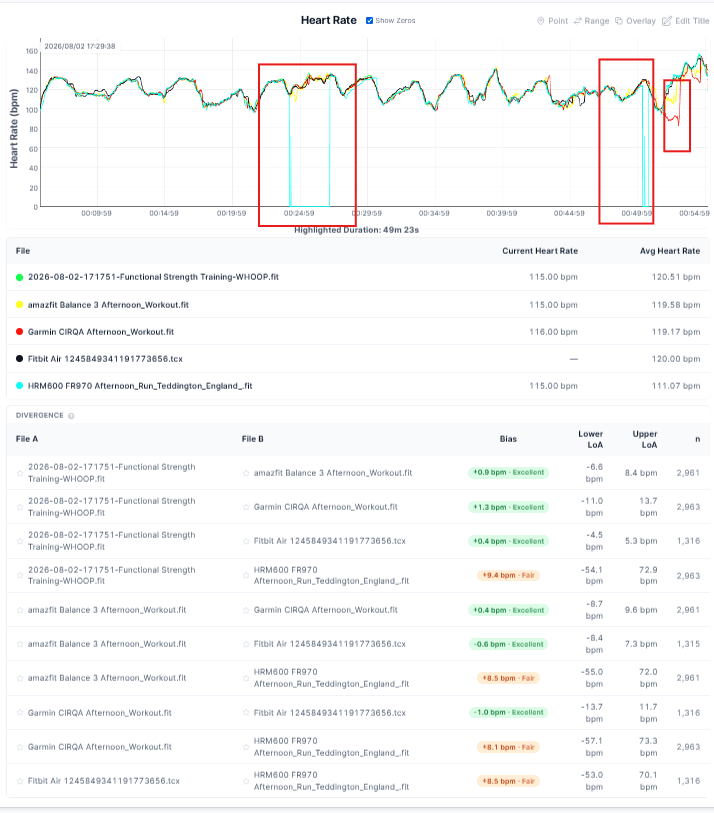
In a HYROX gym simulation test run by The5kRunner, the Whoop MG worn on the bicep tracked closely against a chest ECG strap reference. In a separate HYROX sim at 33 degrees Celsius, the Whoop MG showed near-zero bias against a chest strap reference. That is a genuinely impressive result for a wrist or bicep optical sensor under high-intensity, mixed-modality conditions where cadence lock and motion artefact are constant threats.
In an HR and HRV accuracy test run against multiple devices and reference methods, the Whoop MG worn on the bicep matched a chest-strap ECG to within plus or minus 2.5 bpm. For anyone using HRV as a daily readiness metric, that consistency matters more than almost any other spec.
In a 150-minute Zone 2 endurance ride, the Whoop MG held up well across the full session with no significant accuracy criticisms attached to it specifically.
Where the Whoop MG does not shine is open water swimming. Wrist optical sensors as a category struggle here, and open water is simply a hostile environment for any PPG sensor. The physics of water turbulence, green LED scatter, and the difficulty of maintaining consistent contact make this a known limitation of the technology, not a Whoop-specific failure.
The app ecosystem is functional but polarising. Recovery scores, strain tracking, and sleep staging are well-implemented, but you are fully locked into the Whoop platform. There is no watch face, no notification system, no turn-by-turn navigation. If you want any of that, you need a second device. The lack of GPS onboard is a genuine inconvenience for runners who want pace data without carrying a phone.
Who It's For / Who Should Skip It
The Whoop MG is built for athletes who train seriously at least four to five times a week and want to use recovery data to structure their load. CrossFit athletes, HYROX competitors, cyclists, and anyone already thinking in terms of HRV and readiness scores will get real value from the accuracy and the continuous monitoring. Worn on the bicep, it gives you reference-quality HR data across most training modalities, and the sleep tracking is among the more consistent available from an optical sensor.
Skip it if you want GPS, a display, or a one-time payment. The subscription model is a deal-breaker for budget-conscious buyers, and if you only train three times a week for general fitness, the depth of data will feel like noise rather than signal. Also skip it if open water swimming is a core discipline.
Verdict
The Whoop MG is among the most accurate optical HR monitors tested across multiple high-intensity protocols, and if continuous HRV and recovery tracking are your priority, little at this form factor touches it for data quality. The subscription cost and total absence of a display make it a second device for most people, not a primary one. Buy it only if you are already bought into the Whoop ecosystem logic, because the hardware alone does not justify the ongoing expense.
Where to buy
Whoop MG
7.5/10 — TrackerBrief score