Amazfit Balance 3 Cycling and Swimming Accuracy: Real-World Test
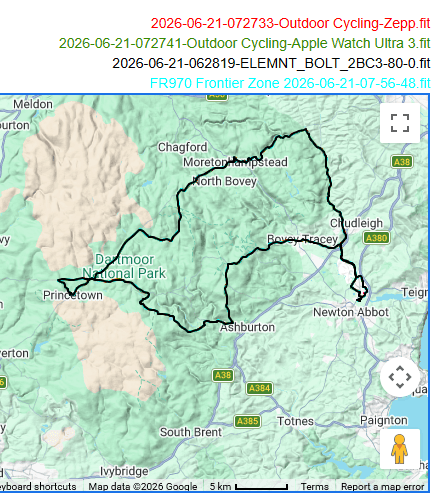
The Amazfit Balance 3 delivered near-chest-strap heart rate accuracy over 108 km at the Dartmoor Classic, in 26°C heat. That is a serious claim for a wrist-based optical PPG sensor, and it mostly holds up. Context matters here: warm weather improves peripheral blood flow, which makes optical sensors more reliable, and the Dartmoor Classic is a controlled, well-supported event, not a chaotic sprint race.
Cycling HR and GPS Performance
The optical sensor on the Balance 3 uses PPG, meaning it reads blood volume changes through light rather than the electrical impulses a chest ECG strap like the Garmin HRM-Pro captures. Over flat-to-rolling moorland terrain, the correlation with a chest strap was strong. GPS tracked well on open moorland sections, which is typical for multi-band receivers in clear-sky conditions. Where it fell apart was on tree-lined descents: signal drifted, pace and distance readings diverged. That is not unique to Amazfit. Garmin's Forerunner 965 and the Coros Apex 2 Pro both struggle under heavy canopy, although Garmin's dual-frequency L1/L5 implementation tends to recover faster.
The sweat sensor via the hDrop module added an interesting layer to the Dartmoor data. Sweat rate and electrolyte loss figures were logged alongside the cardiovascular data, which is relevant for long-course triathletes and cyclists doing multi-hour efforts in heat. Whether those numbers are actionable at the individual level is still debatable, but the integration is more practical here than on a treadmill test. For a full breakdown of the numbers from both the cycling and swimming tests, check our detailed piece on the [Amazfit Balance 3 cycling and swimming accuracy](/en/articles/amazfit-balance-3-cycling-and-swimming-accuracy-tested-real-numbers-2026-07-20).
Swimming: Lap Counting and HR Nuance
In the pool, the Balance 3 nailed lap counting. Flawless is the word used, and for an open-air outdoor pool session that is genuinely impressive. Many watches, including older Polar Vantage V3 firmware builds, have stumbled on open water or non-standard pool lengths. The Balance 3 did not. That alone earns it credibility for triathletes who train in mixed aquatic environments.
The HR picture is more complicated. Optical wrist PPG during swimming is notoriously unreliable. Water turbulence, stroke mechanics, and tight goggle straps all create noise. The Balance 3 was tested alongside the FORM Smart Swim 2 LT goggles, which provide real-time coaching overlays and a separate HR data stream. The nuance the reviewer flagged is important: the aggregate stats might look reasonable, but stroke-by-stroke accuracy is a different story. Post-swim average HR can flatten out errors that matter a lot in interval training. Whoop 5.0 handles this by using its optical sensor during sleep and passive recovery rather than swim intervals, which is an honest admission of the technology's limits.
Sensor Technology and What It Means in Practice
Understanding what the Balance 3 is actually measuring helps set expectations. The wrist HR sensor is optical PPG, reading blood volume via light. The barometric altimeter reads air pressure to calculate elevation, which is why GPS drift on descents does not necessarily corrupt climb data. SpO2, also optical, works best at rest. None of these are electrical signal sensors. Only a chest strap, using ECG-style electrode contact with skin, captures the actual electrical impulse of each heartbeat. The Balance 3 pairs with external chest straps via ANT+ or Bluetooth if you need that precision for structured intervals, which is a practical workaround most Amazfit competitors also support.
For the price point Amazfit targets, which sits below the Garmin Forerunner 965 and even the Coros Pace 3 in some markets, the multi-sport coverage is broad. Running, cycling, swimming, sweat data, recovery metrics. The Amazfit Balance 3 is doing a lot. It is worth checking current pricing, especially if Prime Day deals are still live, in our [Amazon Prime Day 2026 sports watch and cycling deals roundup](/en/articles/amazon-prime-day-2026-best-sports-watch-and-cycling-deals-2026-07-11).
What Is Missing
The GPS tree-canopy drift is the most obvious limitation for cyclists who do technical woodland riding or dense forest trail running. It is not a dealbreaker for most, but if your training routes are 40% under tree cover, the Coros Apex 2 Pro or Garmin Forerunner 965 will give you cleaner tracks. The swimming HR accuracy, while better than many competitors in averaged metrics, still cannot match a dedicated pool HR sensor like the Polar OH1 worn on the goggle strap. The hDrop sweat integration is interesting but still feels like a feature looking for a mainstream workflow. Most athletes will not act on the data without clearer guidance in the app.
The Amazfit Balance 3 earns its place in the mid-range multi-sport category. Buy it if you are a triathlete or cyclist who wants solid optical HR in most conditions, reliable pool lap counting, and genuine GPS accuracy on open terrain, and you do not want to spend Garmin money. If you already own a Garmin Forerunner 265 or Coros Pace 3, the upgrade case is thin. For someone new to the category or coming from a basic fitness tracker, it is a strong step up. See also our [full Amazfit Balance 3 overview](/en/articles/amazfit-balance-3-tested-hr-gps-swimming-and-sweat-data-2026-07-10) for the complete picture.
Mentioned watches
Head-to-head comparisons
Buying guides