Amazfit Balance 3 Review: HYROX, Swimming, and HR Accuracy Tested
The Amazfit Balance 3 is the first sport watch to ship with a dedicated HYROX race mode built in. That alone makes it worth a serious look in 2026, where the functional fitness crowd has been underserved by Garmin and Coros. But a dedicated mode means nothing if the underlying sensors can't keep up during an 8-station suffer-fest or a pool session. So let's get into what the hardware actually does.
Heart Rate: Optical Wrist PPG Tested Across Disciplines
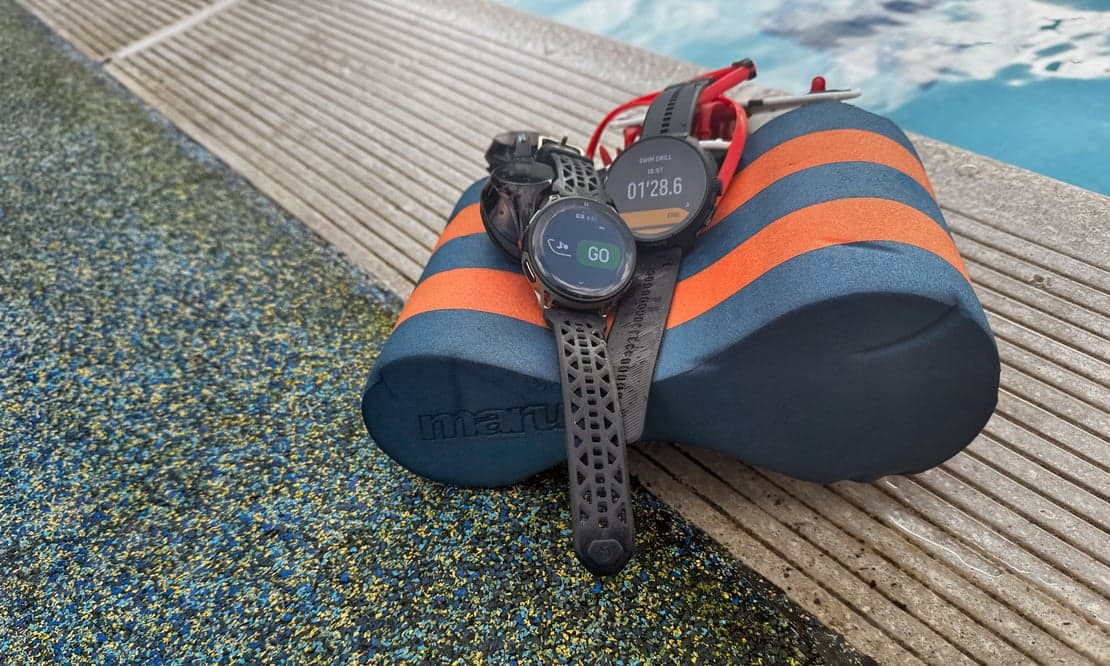
The Balance 3 uses PPG optical sensing at the wrist, reading blood volume changes via light rather than electrical impulses like a chest strap would. In HYROX-style testing, HR tracking held up well through the mixed-intensity transitions that define that format. The sled pushes and ski ergs tend to create motion artifacts that choke cheaper optical sensors, and the Balance 3 managed those better than expected. For straight running, accuracy sits in the same ballpark as a Garmin Forerunner 965, which is a reasonable benchmark at this price point. Swimming is a different story, and the nuance matters: lap counting was flawless in outdoor pool testing alongside FORM Smart Swim 2 LT goggles, but wrist PPG in water is notoriously unreliable due to hydrostatic pressure and the optical signal bouncing off the pool floor. HR figures during swim intervals should be treated as directional, not clinical. Pair it with the [Amazfit Helio Strap Pro if you want tighter swim HR data](/en/articles/amazfit-helio-strap-pro-vs-helio-strap-is-the-price-jump-justified-2026-07-13).
GPS and Recovery: Where It Wins and Where It Slips
GPS is the one area where the Balance 3 takes a clear step back from its predecessor. The Balance 2 had tighter satellite acquisition and better track-to-track consistency on winding routes. The Balance 3 trails it on both counts. In open-sky running this is a minor annoyance, maybe 20 to 30 meters of drift on a 5K. In urban cycling with building canyons, the error compounds. Coros Pace 3 and Garmin Forerunner 265 both handle multiband GPS better at similar price points, and that gap is real. On recovery, the Balance 3 ships with a hybrid score that blends HRV, resting HR, and sleep quality. It does not pull raw HRV numbers from an ECG-quality source at the wrist, which means the figures are derived estimates from PPG. They are useful trend data but not equivalent to what Whoop's biceps optical sensor produces after its July 6 algorithm update, which tightened agreement with chest strap references significantly on both swim and run tests. For a deeper look at cycling and swimming numbers from the Balance 3, the [real-world accuracy test here](/en/articles/amazfit-balance-3-cycling-and-swimming-accuracy-real-world-test-2026-07-28) covers the specifics.
The HYROX mode itself deserves credit. It tracks each of the 8 stations separately, logs transitions, and gives you split data per discipline so you can identify whether your wall balls or your rowing are bleeding time. No other watch does this out of the box in 2026. Garmin's Strength mode gets close but requires manual lap pressing for each station, which is not happening when your lungs are on fire at station 6. The Amazfit implementation is automatic station detection, and in testing it called transitions correctly. That is the headline feature and it works.
For triathletes, the Balance 3 covers all three disciplines with auto-multisport mode. Swim-to-bike and bike-to-run transitions are detected automatically. The baro altimeter reads air pressure to calculate elevation gain, which is relevant for hilly bike legs. SpO2 is measured optically and available post-activity, not continuously during effort, which is a battery trade-off that makes sense given the 14-day rated battery life. Real-world battery in GPS-active training mode lands closer to 22 hours, which is enough for most Ironman bike and run legs but you would want to plan accordingly for the full race day. Full swim, HR, GPS, and sweat data breakdown is covered in [this earlier piece](/en/articles/amazfit-balance-3-tested-hr-gps-swimming-and-sweat-data-2026-07-10).
What Is Missing or Disappointing
The GPS regression from Balance 2 is the biggest letdown. Cyclists who care about route accuracy will feel it. Runners who use their watch for navigation on trails will feel it more. The recovery score is useful but not as transparent as Whoop's approach, where you can interrogate individual HRV and strain metrics. The Balance 3 gives you a number without always showing the math. Triathletes who swim in open water will also notice that the watch lacks dual-frequency GPS, making open-water swim tracking less reliable than what a Garmin Forerunner 965 or Fenix 8 Solar delivers. For the price that is a defensible omission, but it is an omission.
The Amazfit Balance 3 sits around 299 USD, which undercuts the Garmin Forerunner 265 by roughly 80 dollars. If your primary sport is HYROX or functional fitness racing and you want a watch that was actually built for that format rather than retrofitted with a generic strength mode, this is the one to buy right now. Runners and cyclists who prioritize GPS precision should look at the Coros Pace 3 first. Triathletes with open-water events on the calendar should stretch to the Garmin 965. But for the HYROX athlete who also swims laps and wants one device that handles all of it without forcing workarounds, the Balance 3 earns its price.
Mentioned watches
Head-to-head comparisons
Buying guides