Amazfit Prices Up 20% in 2026: Is the Ceiling Near?
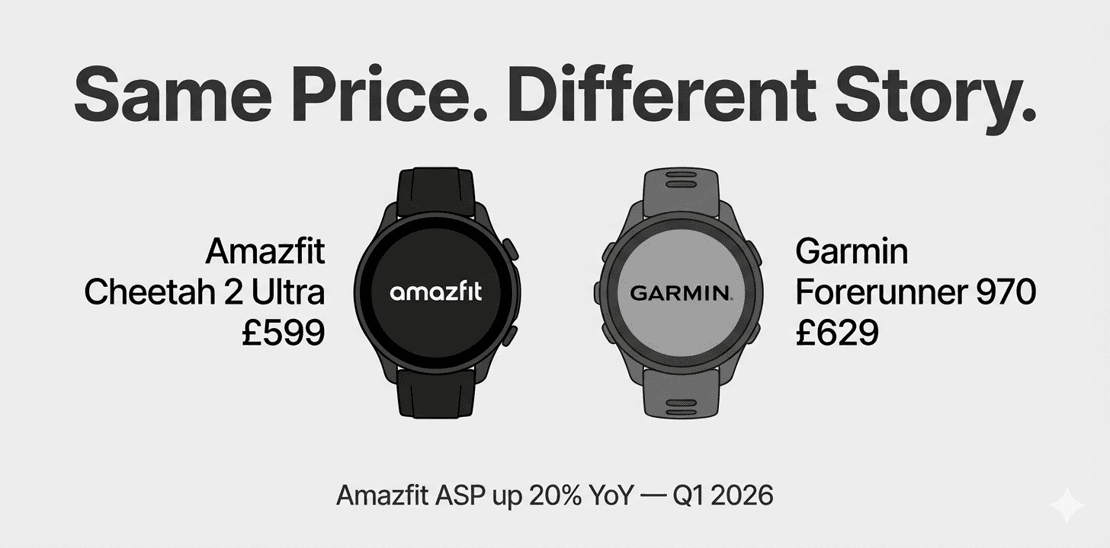
Amazfit's average selling prices climbed more than 20% year-over-year in Q1 2026, and every one of the seven products launched so far this year is holding at full MSRP. No discounting. That is a significant shift for a brand that built its reputation on aggressive value pricing, and it raises a straightforward question: how much will endurance athletes actually pay for an Amazfit before they just buy a Garmin?
A Brand That No Longer Competes on Price Alone
For years, Amazfit's pitch was simple. You got a solid wrist-based optical PPG sensor, dual-band GPS, and a clean training load interface at roughly half the price of comparable Garmin or Coros hardware. The Cheetah Pro at launch was a textbook example: sub-£200 pricing with AMOLED, a barometric altimeter for elevation via air pressure, and running dynamics that held up against the Garmin Forerunner 265. That era is fading. The Cheetah 2 Ultra is now being compared directly to the Garmin Forerunner 970 at the same GBP price point, and that is a fight on entirely different terms. Garmin's ecosystem depth, Connect IQ, and years of chest strap ECG integration data are not easy to match at parity pricing.
Seven products already launched in 2026, with Amazfit sources confirming at least 10 total before year-end. The Falcon 2 has leaked, and there are hints at smart glasses and a camera-equipped wearable. That is a broad product cadence, broader than Coros (which shipped three devices in the same window) and closer to Garmin's pace. Volume alone does not justify premium pricing, but it does suggest Amazfit is building toward a platform play rather than a single flagship strategy. The [Amazfit Q3 2026 software roadmap covering 19 devices and four key features](/en/articles/amazfit-q3-2026-software-roadmap-19-devices-four-key-features-2026-06-18) reinforces that: this is a company investing seriously in software continuity, not just hardware specs.
Sensor Stack and Technical Reality
At the price points Amazfit is now targeting, buyers deserve scrutiny on what they are actually getting. The optical PPG sensors on current Amazfit watches use light to measure blood volume changes at the wrist. That is the same physics as Garmin, Polar, and Apple Watch. What differentiates them is the algorithm on top. Polar's Precision Prime fusion has been a benchmark for wrist HR accuracy on the H10-calibrated scale since 2019. Garmin's Elevate v5 sensor in the Forerunner 970 is better than anything Amazfit shipped before 2025. The Cheetah 2 Ultra's optical sensor performance in real training conditions is documented in detail at [our GPS and heart rate accuracy breakdown](/en/articles/amazfit-cheetah-2-ultra-gps-and-heart-rate-accuracy-real-numbers-2026-06-18), and the numbers are competitive but not dominant. For cycling intervals above 170 bpm, wrist optical still struggles across all brands. A chest strap using electrical impulse measurement remains the reliable solution there, and Amazfit's chest strap ecosystem is thinner than Garmin's or Polar's.
GPS performance is where Amazfit has legitimately closed the gap. Dual-band L1/L5 with multi-constellation support is now standard across the 2026 lineup, same as Garmin Forerunner 970 and Coros Vertix 3S. The barometric altimeter, reading elevation via air pressure rather than GPS altitude, is accurate enough for Hyrox athletes tracking SkiErg or stair segments and for cyclists on rolling courses. SpO2 via optical measurement at the wrist is present, though like every brand, the accuracy during exercise is limited. Treat it as a resting recovery metric, not a live training tool.
What This Means for Athletes Choosing Now
For triathletes, the relevant comparison is ecosystem lock-in. Garmin's triathlon-specific multisport profiles, open-water swim algorithms, and T1/T2 transition handling have years of refinement. Amazfit has improved swim tracking significantly in Zepp OS 6, particularly around multi-device sync that matters if you use a dedicated pool watch and a run watch. The [Zepp OS 6 multi-device sync and iOS notifications explainer](/en/articles/zepp-os-6-amazfit-multi-device-sync-and-ios-notifications-explained-2026-06-18) covers how that workflow actually functions. For pure runners doing structured interval work, the Cheetah 2 Ultra at Forerunner 970 pricing is defensible if you are an Android user. Amazfit's iOS notification handling is now genuinely better than Garmin's, which matters for athletes who monitor training plans and coach messages on the wrist. That specific advantage is covered in our [Amazfit vs Garmin iOS notifications comparison](/en/articles/amazfit-beats-garmin-on-ios-notifications-and-raises-prices-in-2026-2026-06-18).
Recovery tracking is where the pricing question gets trickiest. Whoop 5.0 at its subscription model costs roughly the same annual spend as an Amazfit flagship. Whoop's continuous optical PPG monitoring for HRV and recovery scoring is purpose-built for that job. Amazfit's recovery metrics are improving but still feel secondary to the training focus. For CrossFitters and Hyrox athletes who want a single device for training load and recovery without a subscription, Amazfit at 2026 prices is still a reasonable bet. For anyone whose primary use case is recovery optimization, Whoop or Polar's Nightly Recharge on a Vantage V3 is more purpose-built.
What is missing is straightforward. The third-party app ecosystem is still thin compared to Garmin's Connect IQ. Segment-by-segment navigation for cycling, a real differentiator for Garmin Edge owners moving to a wrist device, is not at the same level. Battery life on the AMOLED flagship models sits around 10 to 14 days in smartwatch mode, similar to Garmin Forerunner 970, but meaningfully behind Coros Vertix 3S at 60-plus days in standard GPS mode. For ultrarunners doing 30-plus hour events, Coros is still the default choice.
Amazfit at 20% higher prices than a year ago is a brand asking to be judged by different standards. It mostly holds up for runners and multisport athletes who want a polished AMOLED interface, solid dual-band GPS, and genuinely good iOS connectivity at a price still slightly below Garmin's top tier. It does not hold up if you need best-in-class chest strap ECG integration, a deep third-party app store, or extreme battery life for ultra-distance events. The Cheetah 2 Ultra at Forerunner 970 pricing makes sense for an Android or iOS runner doing road marathons and 70.3 triathlons who finds Garmin's interface dated. It does not make sense if you are a Garmin Connect data veteran with years of history in the platform. The ceiling may not be in sight yet, but the value argument requires a lot more justification than it did in 2023.
Mentioned watches
Head-to-head comparisons
Buying guides
