Cinder App Review: Apple Watch Recovery Scores With Transparent Formulas
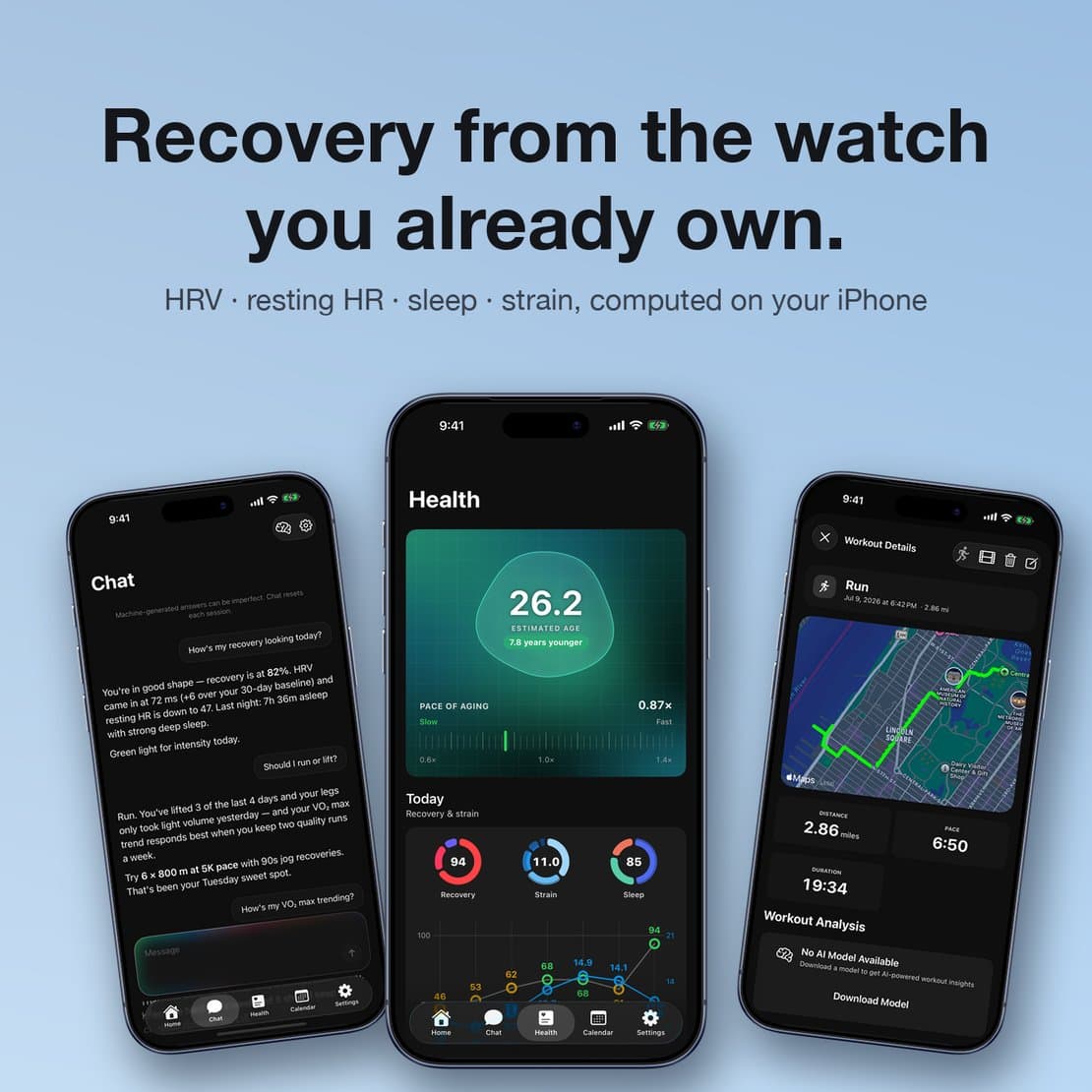
Cinder is a third-party recovery app for Apple Watch that does something almost no competitor bothers to do: it publishes its full calculation methodology inside the app itself. Recovery score, strain score, sleep score, all computed from your Apple Watch optical PPG heart rate data, HRV readings, and sleep tracking, with the math visible to anyone who wants to check it. No extra hardware strap required, no subscription to a separate sensor ecosystem.
How Cinder Pulls and Processes Your Data
Apple Watch uses PPG optical sensors on the wrist, meaning it reads blood volume changes via light, not electrical impulses like a chest strap would. Cinder pulls that raw data through HealthKit, Apple's health data API, and runs its own algorithms on top. The HRV metric it uses is RMSSD, the standard short-term measure of beat-to-beat variation, which is the same baseline metric Whoop, Polar, and Garmin use for their recovery calculations. Cinder's edge is that it tells you the exact weighting it assigns to each variable: sleep duration, HRV, resting heart rate, respiratory rate. That kind of transparency is rare. Whoop charges $239/year and never fully explains its Recovery formula. Garmin's Body Battery is a black box with a fuel gauge metaphor and no published weights.
The strain score works similarly to Whoop's concept, tracking cardiovascular load across the day based on heart rate zones derived from your Apple Watch data. Cinder maps time spent in each zone and computes a cumulative load figure. It is not doing anything that requires special hardware. What it requires is that your Apple Watch is actually recording clean PPG data throughout the day and night, which means fit matters: a loose Apple Watch Series 10 or Ultra 2 on a sweaty wrist at 2am will produce noisier HRV readings than a snug Polar H10 chest strap giving clean ECG electrical impulse data. Cinder cannot fix sensor physics, but it can be honest about its inputs.
Comparing Cinder to Whoop, Garmin, and Polar
Whoop 5.0 remains the benchmark for subscription-based recovery tracking. Its sensor hardware is optimized specifically for overnight HRV capture, and the coaching feedback is genuinely useful for structured training blocks. But you are paying for the hardware and the platform together, and you cannot see the formula. Garmin's Body Battery, available on Fenix 8, Forerunner 965, and Epix Pro, integrates HRV, sleep, and stress into a 0-100 score. It is convenient but equally opaque, and it tends to respond slowly to acute training stress, sometimes showing 70% battery after a hard interval session that clearly wrecked you. Polar's Nightly Recharge on the Vantage V3 is arguably the most physiologically rigorous free recovery metric currently available on a mainstream sports watch, combining ANS recharge and sleep recharge into a clear two-component score.
Cinder sits in a different category: it is software only, running on hardware you already own. If you have an Apple Watch Ultra 2 or Series 10 and are already paying for Garmin or Coros as your training watch, Cinder gives you a second opinion on recovery without adding hardware cost. For athletes who have compared it against Whoop simultaneously, the recovery scores correlate reasonably well on rest days and moderate training days. Where divergence shows up is after very high-load sessions or significant sleep disruption, which is exactly where HRV signal quality matters most and where wrist PPG is at its weakest versus a dedicated chest strap or an arm-worn optical sensor like Whoop's.
Practical Use Cases for Endurance Athletes
For triathletes running a polarized training block, Cinder's strain score gives a daily load number that you can stack against your subjective feel and your Garmin Training Readiness score. Cross-referencing two different algorithmic outputs is more useful than trusting one blindly. Cyclists doing threshold work will find the zone-based strain calculation maps well to effort because cycling keeps heart rate relatively stable within zones compared to interval running. CrossFitters and Hyrox athletes will find the strain score less reliable because intense short-duration glycolytic efforts compress a lot of load into brief spikes that wrist PPG sometimes misses or timestamps inconsistently. Swimmers should note that Apple Watch's waterproofing is fine, but optical heart rate during swimming is notoriously unreliable due to water interference, so any swim sessions will have gaps in the data Cinder is working from.
The sleep scoring component is one of Cinder's stronger areas relative to the competition. Apple Watch's sleep staging has improved through watchOS updates, and Cinder layers its own interpretation over the HealthKit sleep data rather than just re-displaying Apple's own sleep summary. The result is a sleep score that factors in sleep timing consistency and HRV during specific sleep stages, not just total duration. Compared to Whoop's sleep coach or Garmin's Sleep Score, it holds up reasonably well for a no-hardware-cost solution. Coros still lacks serious sleep analysis depth in 2026, so if you run a Coros Pace 4 as your training watch, Cinder on Apple Watch as a secondary device for overnight recovery tracking is a genuinely practical combination.
What Cinder is missing is worth being clear about. There is no coaching layer that tells you what to do with the scores. Whoop's journal feature and coaching prompts, Polar's FitSpark daily training suggestions, and Garmin's suggested workouts all close the loop between recovery data and training decisions. Cinder gives you numbers and the formulas behind them, then leaves the interpretation to you. The app interface is functional but not polished to the level of Whoop or even the Polar Flow app. There is also no web dashboard, no data export to CSV or third-party training load platforms, and the historical trend view is limited compared to what you get from a Garmin Connect subscription or the COROS app. The COROS June 2026 update added Heart Rate Recovery tracking and AllTrails integration, which shows how much Coros is investing in the analytics layer that Cinder currently lacks. For athletes who want context, related Apple Watch app comparisons are worth checking, including [TouchTrails vs Tooboo for offline navigation on Apple Watch](/en/articles/touchtrails-vs-tooboo-apple-watch-offline-navigation-apps-compared-2026-2026-07-28).
Cinder is for the analytically curious athlete who already owns an Apple Watch and wants to understand recovery metrics rather than just consume them. No subscription fee on top of Apple hardware is a real advantage. If you are a triathlete or runner who trains with a coach and wants actionable daily guidance, Whoop 5.0 or Polar Vantage V3 will serve you better. But if you are the kind of athlete who reads methodology sections and wants to know why your recovery score is 68 instead of 74, Cinder is worth installing. Free to try, with transparent math. That alone puts it ahead of most of the field.
Mentioned watches
Head-to-head comparisons
Buying guides