COROS June 2026 Update: Heart Rate Recovery, Battery Health, AllTrails
COROS pushed a significant firmware update in June 2026, landing three distinct features across most of its current lineup: automated heart rate recovery tracking, a battery health diagnostic page, and a native AllTrails integration. This is not a minor patch. These are features athletes have been requesting for months, and they land on the PACE 3, APEX 2 series, and VERTIX 2S.
Heart Rate Recovery Tracking
Heart rate recovery (HRR) measures how fast your optical PPG sensor on the wrist reads the drop in beats per minute after a hard effort stops. COROS is now automating that capture, meaning the watch detects the end of a high-intensity interval and logs the one-minute and two-minute recovery values without you pressing anything. That matters for triathletes and runners doing structured work: you get a consistent data point every session without fumbling with lap buttons. Garmin has offered manual HRR logging for years on the Forerunner 965 and Fenix 8, but the automation piece is less seamless there. Polar's Vantage V3 surfaces recovery data through its own recovery pro metric, which is more integrated into training load but less transparent on raw BPM drop numbers.
The actual physiological value here is real. A drop of 12 BPM or less in the first minute post-effort is a known marker of poor cardiovascular fitness or accumulated fatigue. Elite endurance athletes often see drops of 25 to 30 BPM in that same window. Having this tracked automatically across a training block gives you a longitudinal view that a single Whoop HRV reading does not. Whoop captures overnight recovery trends via optical PPG but does not give you acute post-interval HRR. These are complementary, not competing, data points.
Battery Health Diagnostic
The battery health page is practical and overdue. COROS watches like the VERTIX 2S ship with a rated 60-day battery life in standard mode, and the APEX 2 Pro sits around 75 hours in GPS mode. Over two to three years of daily use, lithium-ion cells degrade. This new diagnostic surface tells you what percentage of original capacity your battery currently holds, similar to what Apple Watch has shown in settings since watchOS 7 and what Garmin quietly added to some Edge cycling computers. For athletes who bought a PACE 3 in 2023 and are still racing on it, knowing your cell is at 78% capacity explains why your GPS sessions are cutting short on long ultras. It is a transparency feature, but a genuinely useful one.
AllTrails Integration
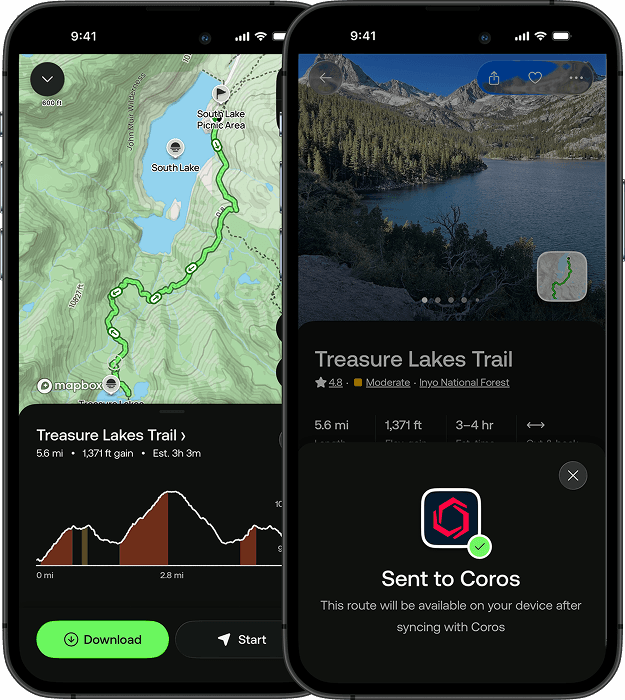
The AllTrails integration lets you push routes directly from the AllTrails app to your COROS watch, with the course appearing as a breadcrumb trail on the map display. No GPX export, no file transfer, no desktop app. For trail runners and hikers, this is a friction reduction that matters on race week. We reviewed this integration in detail separately at [COROS AllTrails Integration Reviewed: Functional but Behind Garmin](/en/articles/coros-alltrails-integration-reviewed-functional-but-behind-garmin-2026-07-03). The short version: it works, route syncing is fast, but the on-watch map rendering and rerouting intelligence lag behind what Garmin delivers on the Fenix 8 with its TopoActive maps and turn-by-turn prompts. COROS gives you the line. Garmin gives you the line plus context.
For cyclists using COROS, AllTrails is largely irrelevant since the platform skews hiking and trail running. Wahoo and Garmin remain the smarter choices for road and gravel routing. CrossFitters and Hyrox athletes will skip this feature entirely and care more about the HRR automation and whether COROS has fixed any interval detection quirks, which brings us to firmware stability.
This update has not been without friction. Early reports flagged some HRR logging inconsistencies on the PACE 3 where the watch failed to detect the end of an interval if the athlete slowed gradually rather than stopping fully. That is a real-world edge case in fartlek training and trail racing. COROS acknowledged the behavior. We are tracking reported bugs from this and adjacent firmware cycles at [Garmin, Suunto, COROS Firmware Bugs: July 2026 Roundup](/en/articles/garmin-suunto-coros-firmware-bugs-july-2026-roundup-2026-07-22). The battery health page also does not yet show a replacement recommendation threshold, which Apple Watch does at 80%. You get the number but no actionable guidance.
What is missing is deeper: COROS still has no equivalent to Garmin's Training Readiness score or Polar's Nightly Recharge in terms of a single synthesized recovery signal that combines HRV, sleep, and HRR into one daily number. The HRR data is now there. The sleep optical PPG data is there. COROS has the inputs. They are not yet connecting them into an output athletes can act on at 6am before a session. That gap is getting harder to ignore in 2026 when Garmin and even Amazfit are surfacing consolidated readiness scores.
Bottom line: this update is worth installing immediately if you are on a COROS APEX 2 Pro or VERTIX 2S and do structured interval training. The automated HRR logging alone justifies the update. If you are cross-shopping a new watch and the AllTrails integration is a deciding factor, test it against a Garmin Fenix 8 first, especially if you run technical trails with poor cell service. COROS at its price points, roughly $349 for the PACE 3 and $699 for the APEX 2 Pro, still offers the best battery-to-price ratio in the category. This update makes the platform more competitive on data depth, but Garmin's ecosystem lead on third-party integrations and synthesized metrics remains real.
Mentioned watches
Head-to-head comparisons
Buying guides