Correlate App: Apple Watch Recovery Scores With Delayed-Effect Testing
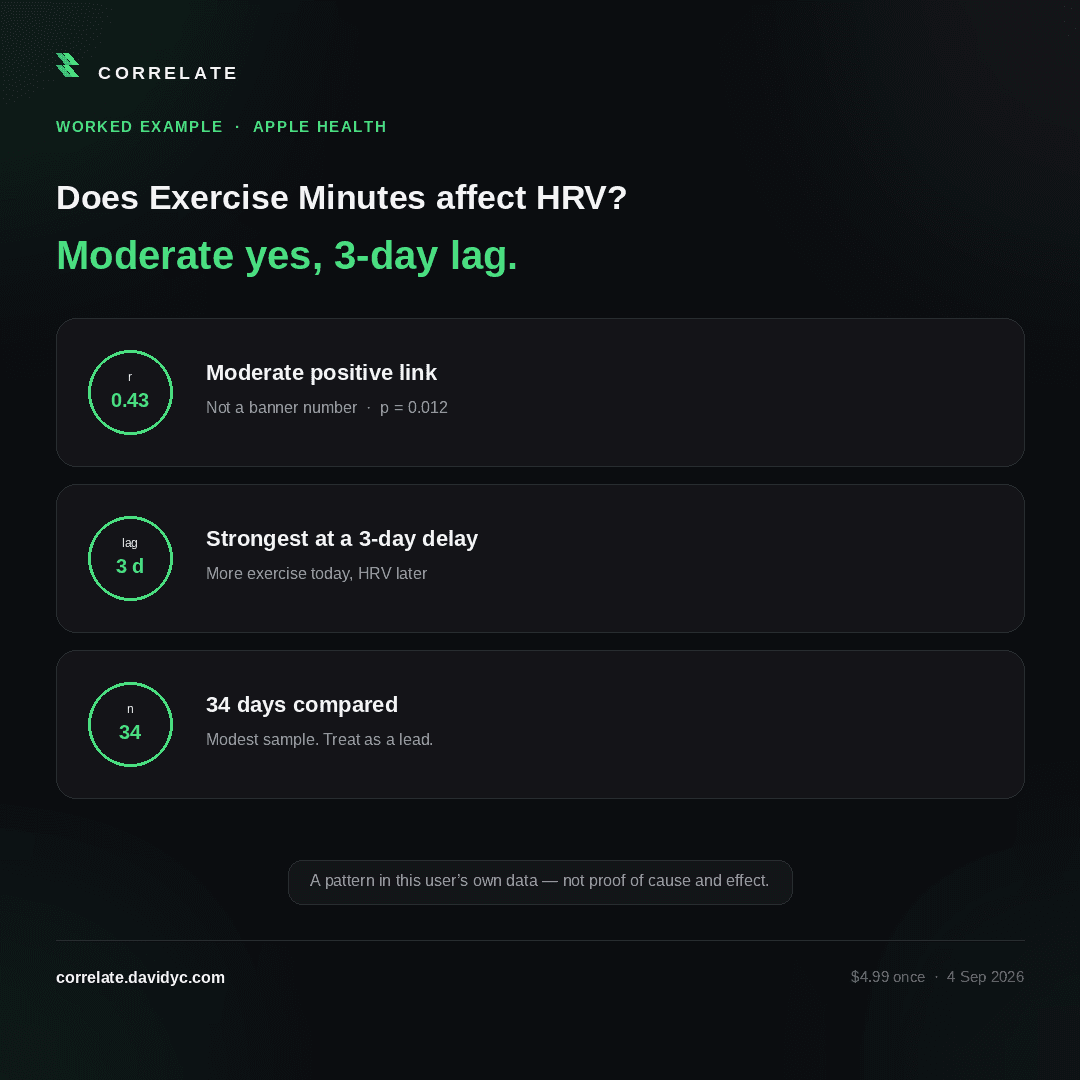
Correlate is a $4.99 one-time purchase iPhone app that turns your Apple Watch into a recovery, strain, and sleep tracking platform. It runs entirely on-device, no subscription, no cloud sync. That alone puts it in a different category from most wearable ecosystems in 2026.
What Correlate Actually Does
The core idea is simple but genuinely useful: Correlate pulls Apple Health data already collected by your Apple Watch and builds recovery and strain scores from it. The watch uses PPG optical sensors on the wrist to measure heart rate variability, resting heart rate, and blood volume pulse, and Correlate interprets that data through its own scoring layer. What sets it apart is the delayed-effect correlation engine, which lets you test whether a specific variable, say alcohol intake, sleep duration, or training load, actually impacts your recovery scores one, two, or three days later on your own personal dataset. This is not generic population data. It is your data, your patterns.
The Apple Watch Series 10 and Ultra 2 collect HRV via PPG at the wrist during sleep, not via electrical impulse like a chest strap ECG would. That distinction matters. Wrist-based HRV readings have more motion artifact risk and are generally less precise than a Polar H10 or Garmin HRM-Pro chest strap during active measurement windows. Correlate works within those hardware constraints, not around them. What you get is consistent enough for trend tracking, which is what recovery scoring actually needs.
Sensors, Data Sources, and On-Device Processing
All processing stays on your iPhone. There is no account to create, no server to trust with your biometric history. Correlate reads from Apple Health, which aggregates optical PPG data from your Apple Watch, sleep staging, and any third-party inputs you have enabled. The baro altimeter on the Apple Watch measures air pressure for elevation, the GPS uses satellite positioning for outdoor workouts, and SpO2 uses a separate optical wavelength at the wrist. Correlate does not claim to reinvent sensor fusion. It uses what the Apple Watch already measures and adds the analytical layer that Apple's own Vitals app and Activity rings never bothered to build.
For comparison, Whoop 5.0 uses its own proprietary PPG optical sensor and charges $30 per month to give you a recovery score and strain metric. Garmin's Body Battery on a Forerunner 965 or Fenix 8 does similar strain-and-recovery math but lives inside Garmin Connect and only works with Garmin hardware. Coros does not offer a native recovery score yet, though their [June 2026 update added heart rate recovery tracking](/en/articles/coros-june-2026-update-heart-rate-recovery-battery-health-alltrails-2026-07-28). Correlate costs $4.99 once and works with the Apple Watch you already own. The math is straightforward.
Correlation Testing: The Feature That Matters Most
The delayed-effect correlation tool is the real differentiator. You can ask the app: does my caffeine intake at 3pm predict worse HRV two nights later? Does a long ride above threshold drop my recovery score for 48 hours? These are questions that Whoop's journal feature gestures at but never answers with statistical rigor on your personal n-of-1 dataset. Correlate actually runs the correlation. For triathletes managing big training blocks, cyclists tracking fatigue across a stage week, or Hyrox athletes loading heavy in the gym, this feedback loop is legitimately actionable. It is the kind of insight a coach or sports scientist would try to extract manually from a spreadsheet.
If you have looked at similar tools, the [Cinder app does Apple Watch recovery scoring with transparent formula breakdowns](/en/articles/cinder-app-review-apple-watch-recovery-scores-with-transparent-formulas-2026-08-19), and the [Vitara app turns Apple Health data into broader training insights](/en/articles/vitara-app-turns-apple-health-data-into-athlete-training-insights-2026-07-21). Correlate occupies a more analytical niche focused specifically on the correlation engine rather than general training load management.
What Correlate lacks is real-time feedback during workouts, any form of GPS route analysis, or structured training recommendations. It is a retrospective analysis tool, not a training platform. There is no Android version, no Apple Watch app face, and no way to export your correlation results in a shareable format. The UI is functional but sparse. If you want guided workouts, smart recovery nudges, or a polished dashboard, this is not that product. Athletes who need swimming metrics or multisport logging will need to look elsewhere.
Correlate is built for data-literate endurance athletes who already wear an Apple Watch and want to extract more signal from it without paying a monthly fee. At $4.99 it undercuts every subscription-based recovery platform on the market. It will not replace a dedicated recovery device or a chest strap for precise HRV measurement, but as an analytical layer on top of hardware you already own, it earns its keep. Compare it to Whoop at $360 per year or Garmin's ecosystem lock-in. For the Apple Watch athlete who wants answers, not just scores, Correlate is worth the download.
Mentioned watches
Head-to-head comparisons
Buying guides