Garmin Cirqa Sensors Confirmed: SpO2, Skin Temp, Muscle Battery Ahead
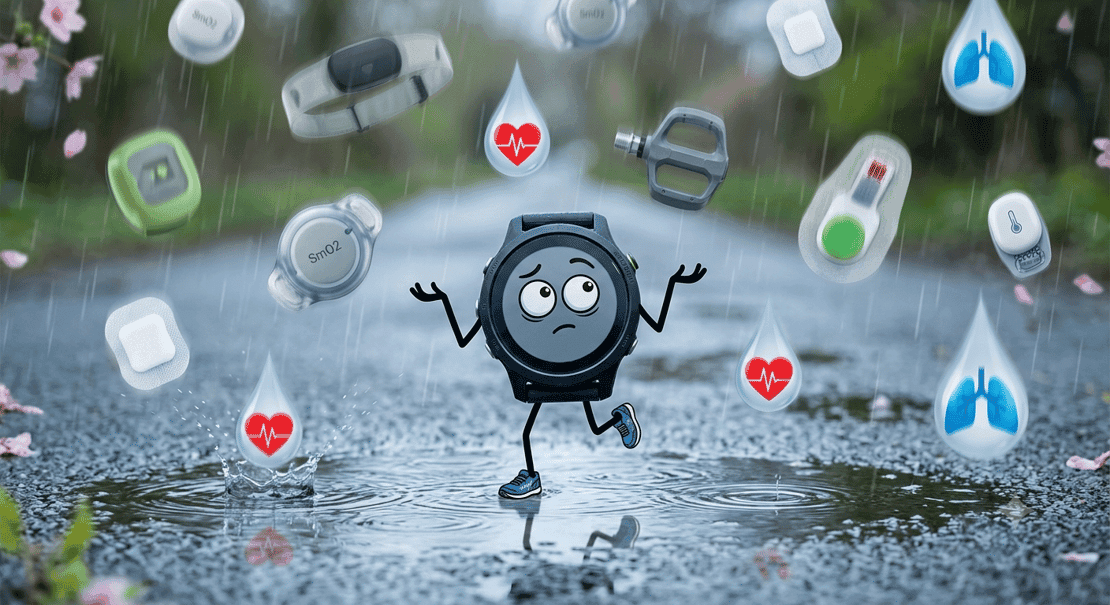
A leaked Romanian Garmin support page briefly listed the Cirqa as a Health Status compatible device before being pulled in July 2026. That listing confirmed two sensors that were previously assumed but never verified: SpO2 and skin temperature. Short-lived as the page was, leaks from official support infrastructure carry more weight than rumor sites.
What the Confirmed Sensors Actually Do
SpO2 on the Cirqa works the same way it does on the Fenix 8 or Polar Vantage V3: a PPG-based optical sensor shines red and infrared light into your blood vessels and measures relative absorption to estimate blood oxygen saturation. This is not an electrical signal. It is light bouncing off blood volume under your skin. Skin temperature uses a dedicated thermistor or infrared sensor sitting against the wrist, giving continuous baseline data useful for illness detection, recovery tracking, and female health metrics. Garmin already pairs these two sensors on the Venu 3 and Forerunner 965 for its Body Battery and morning report features. On the Cirqa, the expectation is deeper integration with Health Status, Garmin's platform-level wellness dashboard that aggregates HRV, sleep, stress, and readiness into a single daily score.
For athletes, SpO2 matters most at altitude. If you are doing a mountain ultra or a high-altitude triathlon camp above 3,000 meters, continuous or on-demand SpO2 readings can flag early acclimatization stress before performance drops. Skin temperature adds a recovery layer: a spike of 0.3 to 0.5 degrees Celsius above your baseline on waking often precedes illness or overtraining signals by 12 to 24 hours. Whoop 5.0 leans heavily on skin temp for its recovery score. Garmin is catching up.
Muscle Battery: Real Trademark, Unbuilt Hardware
Garmin trademarked the name Muscle Battery in early 2026, and this is where things get genuinely interesting for endurance athletes. Muscle Battery almost certainly refers to muscle oxygen saturation (SmO2), the metric that near-infrared spectroscopy (NIRS) sensors like Moxy or BSX have tracked for years. SmO2 tells you in real time how well your muscles are extracting oxygen during exercise, which is a more direct measure of local fatigue than heart rate or even VO2 estimates. The problem is hardware. No current Garmin wrist device carries a NIRS sensor. The optical depth required to reach muscle tissue is far beyond what any PPG sensor achieves at the wrist. Garmin would need either a dedicated arm-clip module, a new strap accessory, or a placement like the upper arm used by some Polar optical sensors. For more on Garmin's broader hardware roadmap and what the [Garmin Enduro 4 launch tells us about Connect IQ 9](/en/articles/garmin-enduro-4-connect-iq-9-helio-strap-pro-what-athletes-need-to-know-2026-07-22), the picture becomes clearer.
Hydration sensing is another metric floating around Garmin's research pipeline. Bioimpedance sensors, already present in some Withings and Fitbit devices, pass a tiny electrical current through the skin to estimate fluid levels. Garmin has the bioimpedance hardware in some of its body composition scales. Wrist integration is technically feasible but accuracy at the wrist remains inconsistent across skin tones and sweat levels. Expect Garmin to leave biochemical frontiers like continuous lactate or glucose to third-party CGM integrations rather than building the sensors itself.
Cirqa in Context: Where It Sits Against the Competition
The Cirqa appears positioned between the Venu 3 health focus and the Forerunner performance focus. If the leaked Health Status compatibility holds, it targets users who want deep wellness tracking without paying Fenix 8 prices. Coros has the Pace 3 and Vertix 3 covering performance at lower prices, but Coros recovery metrics remain thin compared to Garmin's ecosystem. Polar's Grit X2 Pro has strong HRV and skin temperature integration but lacks Garmin's Connect IQ app library. Whoop 5.0 still wins on pure recovery analytics but has no GPS, no display, and no training metrics. The Cirqa, if it ships with SpO2, skin temp, HRV4Training-compatible HRV, and a solid optical PPG heart rate sensor, would cover 90 percent of what most triathletes and runners actually need. You can also check the latest [wearables news roundup from July 2026](/en/articles/screenless-bands-garmin-lawsuit-apple-ai-wearables-news-july-2026-2026-07-22) for the broader competitive landscape.
What is missing or disappointing at this stage is the absence of any confirmed chest strap ECG integration announcement. The Cirqa's wrist optical sensor will estimate heart rate via PPG, which is fine for steady-state running and cycling but degrades during high-intensity intervals and heavy arm movements like CrossFit or Hyrox. Garmin's own HRM-Pro Plus strap picks up electrical impulses directly from the heart muscle and feeds running dynamics to the watch. If Cirqa launches without tight HRM-Pro pairing and running dynamics support, it will feel incomplete for serious runners. Pricing is also unconfirmed. If it lands above 449 euros, it will have to justify itself hard against the Forerunner 965, which already does most of this.
Buy the Cirqa if you are a health-focused endurance athlete who wants Garmin's ecosystem at a non-Fenix price point and cares more about recovery trends than elite navigation features. If you are primarily a performance athlete who lives and dies by pace, power, and route mapping, the Forerunner 965 or Coros Vertix 3 remains the smarter spend. The Muscle Battery trademark is exciting. Just do not expect that sensor to ship in 2026.
Mentioned watches
Head-to-head comparisons
Buying guides