Amazfit Cheetah 2 Ultra GPS and Heart Rate Accuracy: Real Numbers
The Amazfit Cheetah 2 Ultra scores 85% on GPS accuracy testing and delivers five Excellent heart rate sessions from six attempts. At £599.90, it sits at the same price point as the Garmin Forerunner 970, and for the first time, an Amazfit watch can be mentioned in the same breath as Garmin's top running hardware without that sounding generous.
GPS: Dual-Frequency GNSS and What the Numbers Mean
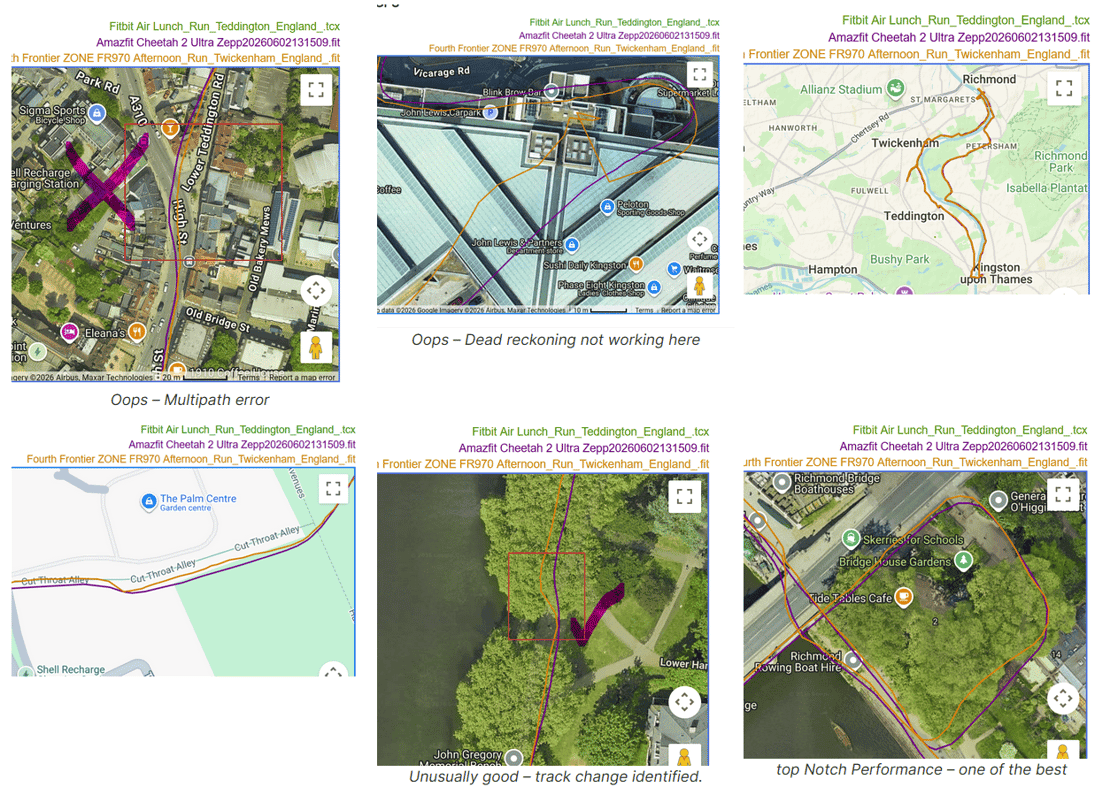
Dual-frequency GNSS is confirmed on the Cheetah 2 Ultra, and it shows in the data. The standardised 10-mile GPS accuracy test returned 81% in one test protocol and 85% in the full trail review, both figures ahead of the previous Cheetah 2 Pro at 73%. The Forerunner 970 still wins on that same test. That gap matters if you're racing technical trail courses where track deviation of even a few metres compounds over 50K. For road runners and most triathletes doing brick workouts, the Cheetah 2 Ultra's GPS is clean enough that you won't be chasing phantom kilometres. Coros Pace 3 sits around 80% on comparable tests, so the Cheetah 2 Ultra is genuinely competitive here.
The 55-hour GPS battery projection is the number that trail runners will care about most after accuracy. Garmin's Forerunner 970 offers longer endurance in its UltraTrac modes, but 55 hours in what Amazfit specifies as a standard GPS mode is serious. It covers a 100-mile mountain race for most finishers. That's not a trimmed-down satellite mode with compromised positional accuracy , the 55-hour figure appears tied to the watch's normal dual-frequency operation, which makes it more useful than the headline UltraTrac numbers some competitors advertise.
Heart Rate Accuracy: Optical Sensor on Wrist
Five Excellent results from six HR sessions is the strongest optical PPG performance Amazfit has published from this line. The wrist sensor works via light-based blood volume detection, not electrical signals, so it's susceptible to the usual optical limitations: hard efforts, high cadence cycling, and cold conditions all degrade signal quality. The sixth session in testing was not rated Excellent, which is worth keeping in mind. Polar's H10 chest strap, which uses electrical impulse detection like an ECG, remains the reference if you need sub-beat-level accuracy for structured interval sessions. For most training runs and long aerobic efforts, the Cheetah 2 Ultra's optical sensor keeps up. Check the [full HR accuracy breakdown across bike, Hyrox, and heat testing](/en/articles/amazfit-cheetah-2-ultra-hr-accuracy-bike-hyrox-and-heat-tested-2026-06-01) for session-by-session data.
For Hyrox athletes, the combination of optical HR and barometric altimeter (air pressure based, not GPS elevation) gives you floor-level tracking during sled push and sandbag lunges that GPS alone can't resolve indoors. That's a real practical edge over relying on GPS altitude during indoor competition. Whoop 5.0 captures recovery data more granularly if you're stacking HRV and sleep metrics, but it doesn't replace a GPS watch on race day. The Cheetah 2 Ultra tries to do both in one device , recovery metrics included , with mixed but improving results.
Trail-Specific Features and Build
The trail-specific features work. That's the short version. Navigation, grade-adjusted pace, and the physical build all tested well. The watch runs [Zepp OS 6](/en/articles/zepp-os-6-amazfit-multi-device-sync-and-ios-notifications-explained-2026-06-18), which now handles multi-device sync and improved iOS notifications. Software stability has been a historical weakness for Amazfit against Garmin's Connect ecosystem, and Zepp OS 6 closes some of that gap without fully closing it. Garmin's training load analysis and race predictor tools are still deeper and more trusted by serious athletes.
Zepp Health's financial picture is worth a brief mention here because it affects the long-term software support question. The company posted 33.8% revenue growth in Q1 2026 with improving margins, but the share price dropped 19% in five days. Wall Street is waiting for a clear profitability timeline. For buyers making a five-year watch decision, that's a legitimate consideration. Garmin is profitable and not going anywhere. Amazfit is growing but still burning cash at a rate that raises questions about ecosystem longevity.
What's missing is straightforward. The Forerunner 970 beats it on GPS accuracy, ecosystem depth, and third-party app support. The Cheetah 2 Ultra has no significant advantage in SpO2 optical sensing , both watches use light-based pulse oximetry, and neither is a clinical tool. Mapping on the Cheetah 2 Ultra is present but limited compared to Garmin's full topographic maps. If you train heavily with a power meter on the bike and expect seamless integration, Garmin and Coros are more reliable choices today.
The Amazfit Cheetah 2 Ultra is the right buy for trail runners and ultra-distance athletes who want serious GPS battery life, solid optical HR, and a capable trail interface at £599.90 without committing to the Garmin ecosystem. It's not the right call for data-obsessed triathletes who live in Garmin Connect or cyclists who need deep power meter analytics. Against the Forerunner 970 at the same price, the Garmin wins on ecosystem and peak GPS precision. The Cheetah 2 Ultra wins on battery and represents genuinely good value if Amazfit's software trajectory continues. See the [detailed sensor and SmO2 test results](/en/articles/amazfit-cheetah-2-ultra-review-gps-hr-and-smo2-tested-2026-06-08) before deciding.
Mentioned watches
Head-to-head comparisons
Buying guides