Garmin CIRQA Firmware Update: What Actually Changed and Why It Matters
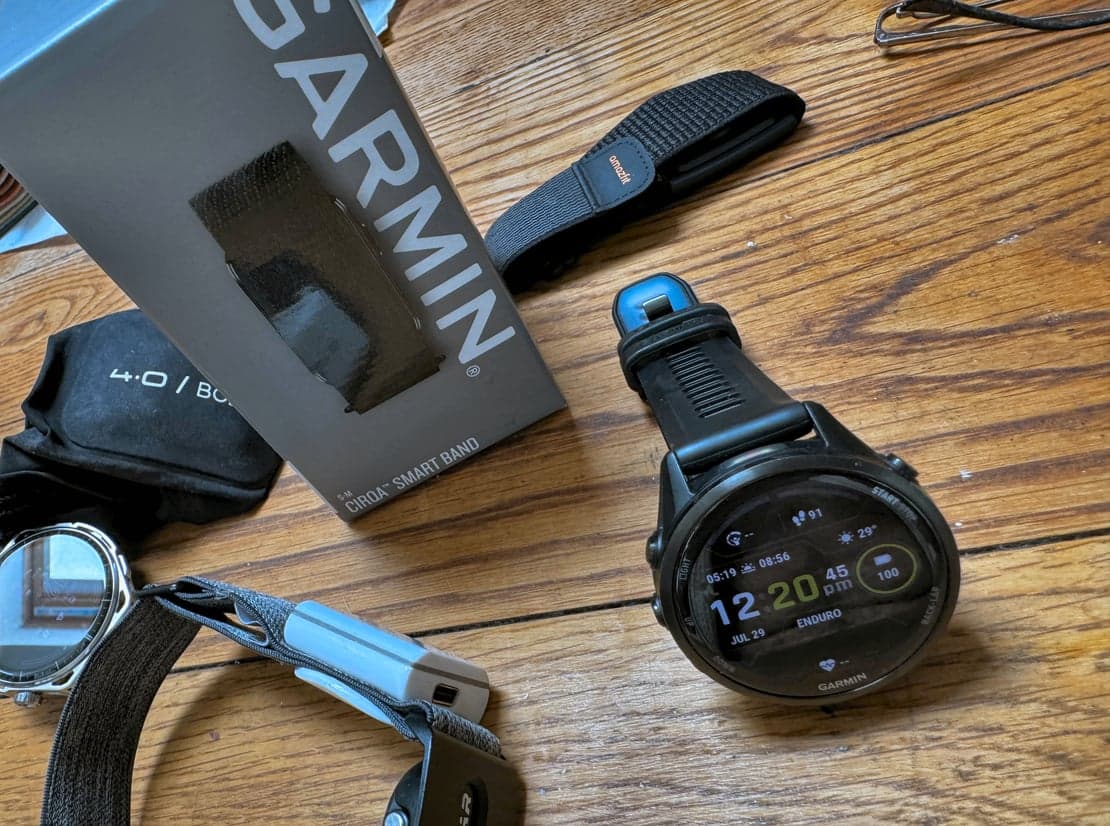
Garmin pushed a significant firmware update to the CIRQA, and this one is not a routine patch. The changelog is substantial enough that athletes who shelved the watch after early frustrations should take another look. Firmware updates on sport watches can quietly fix the bugs that matter most to daily training, and this appears to be one of those releases.
What the CIRQA Update Actually Fixes
The details from the5kRunner's breakdown point to meaningful fixes rather than cosmetic tweaks. Garmin's CIRQA runs optical PPG sensors on the wrist for heart rate and heart rate variability, and early versions shipped with accuracy complaints that hit hardest during high-intensity intervals. When your wrist PPG is misreading cadence lock as heart rate during a 400m repeat, your training load data collapses downstream. That is the kind of bug that corrupts recovery scores, VO2 max estimates, and race predictions simultaneously.
For cyclists, a bad optical read at 180 watts is annoying. For runners doing structured workouts through something like [RunSync's AI-generated plans](/en/articles/runsync-builds-structured-garmin-workouts-with-ai-and-training-paces-2026-09-03), it actively breaks the feedback loop those platforms depend on. The CIRQA update apparently addresses core sensor reliability, which matters more than any new feature Garmin could have added.
How This Stacks Up Against the Competition
Let's be direct about where the CIRQA sits in 2026. The Garmin Forerunner 965 and Epix Pro still lead on GPS multi-band accuracy, pulling satellite fixes from GPS, GLONASS, Galileo, and BeiDou simultaneously. Coros Pace 3 remains the battery-life benchmark at around 38 hours in full GPS mode versus most Garmin optical-sensor watches sitting in the 20 to 30 hour range. Polar's H10 chest strap, which uses electrical ECG signals rather than optical light, still outperforms any wrist PPG device for raw heart rate accuracy during hard efforts, including the CIRQA post-update.
Whoop 5.0 has no GPS at all and leans entirely on optical HRV for recovery. The CIRQA competes differently: it is a self-contained training watch trying to do GPS tracking, optical heart rate, barometric altitude via air pressure sensor, and recovery metrics in one unit. That is a harder engineering problem, and firmware iteration is how Garmin closes the gap between launch hardware and mature performance.
Calorie accuracy is worth flagging separately. A recent FIU study found [Garmin ranked worst among four major smartwatches for calorie estimation accuracy](/en/articles/fiu-study-garmin-calorie-accuracy-worst-among-four-major-smartwatches-2026-09-03). That is a platform-wide issue tied to Garmin's energy expenditure algorithms, not specific to CIRQA hardware. No firmware update on the CIRQA will fix a systemic calorie model problem. Athletes using the watch for weight management or fueling calculations should account for that bias manually.
Real-World Use Cases After the Update
For triathletes, the key question is swim-to-bike-to-run transition reliability and whether optical heart rate recovers quickly after immersion. Post-firmware, early reports suggest the CIRQA's PPG sensor stabilizes faster after pool exits, which is a genuine improvement for brick sessions. Hyrox athletes doing repeated functional movements will stress the optical sensor differently than steady-state runners, and motion artifact rejection during sled pushes or burpees is where wrist PPG typically falls apart on all brands.
Runners doing easy aerobic miles will likely see the biggest benefit from this update. Heart rate zone accuracy at 140 to 155 bpm during a Zone 2 session is where PPG sensors perform best anyway, and the firmware appears to clean up the edge cases at the high end. Cyclists using the CIRQA without a chest strap should pair it with a Garmin HRM-Pro or Polar H10 for any structured intervals above threshold. The electrical ECG signal from a chest strap will always win on precision at high intensities, regardless of firmware version.
What is still missing is broader third-party integration. Garmin's Connect IQ ecosystem is mature, and features like [live CGM glucose overlays from Sugar Sense](/en/articles/sugar-sense-brings-live-cgm-glucose-data-to-140-garmin-watches-2026-09-03) now work on 140-plus Garmin devices. Clarity on whether the CIRQA is in that supported list matters for athletes managing blood sugar during long efforts. The [Garmin Forerunner 70](/en/articles/garmin-forerunner-70-review-gps-battery-and-real-world-results-2026-09-02) sits below the CIRQA in the lineup and may actually cover more use cases for athletes who do not need the CIRQA's specific feature set.
The honest disappointment here is timing. A firmware update this significant arriving well after launch means early adopters spent weeks or months training on a watch that was not performing to spec. That is a real cost for athletes mid-season. Garmin's update cadence is generally reliable, but shipping hardware with bugs this foundational is a pattern that keeps repeating across the lineup.
The CIRQA post-update is worth reconsidering for runners and triathletes who want Garmin's ecosystem without paying Epix Pro prices. If you already own one, install the update immediately. If you are choosing between the CIRQA and a Coros Pace 3, the Coros still wins on battery and GPS efficiency. If you are deep in Garmin Connect and want the training load ecosystem to function properly, the CIRQA now does what it was supposed to do at launch.
Mentioned watches
Head-to-head comparisons
Buying guides