Garmin Enduro 4 Leaked: Expected Specs, Price, and Release Date
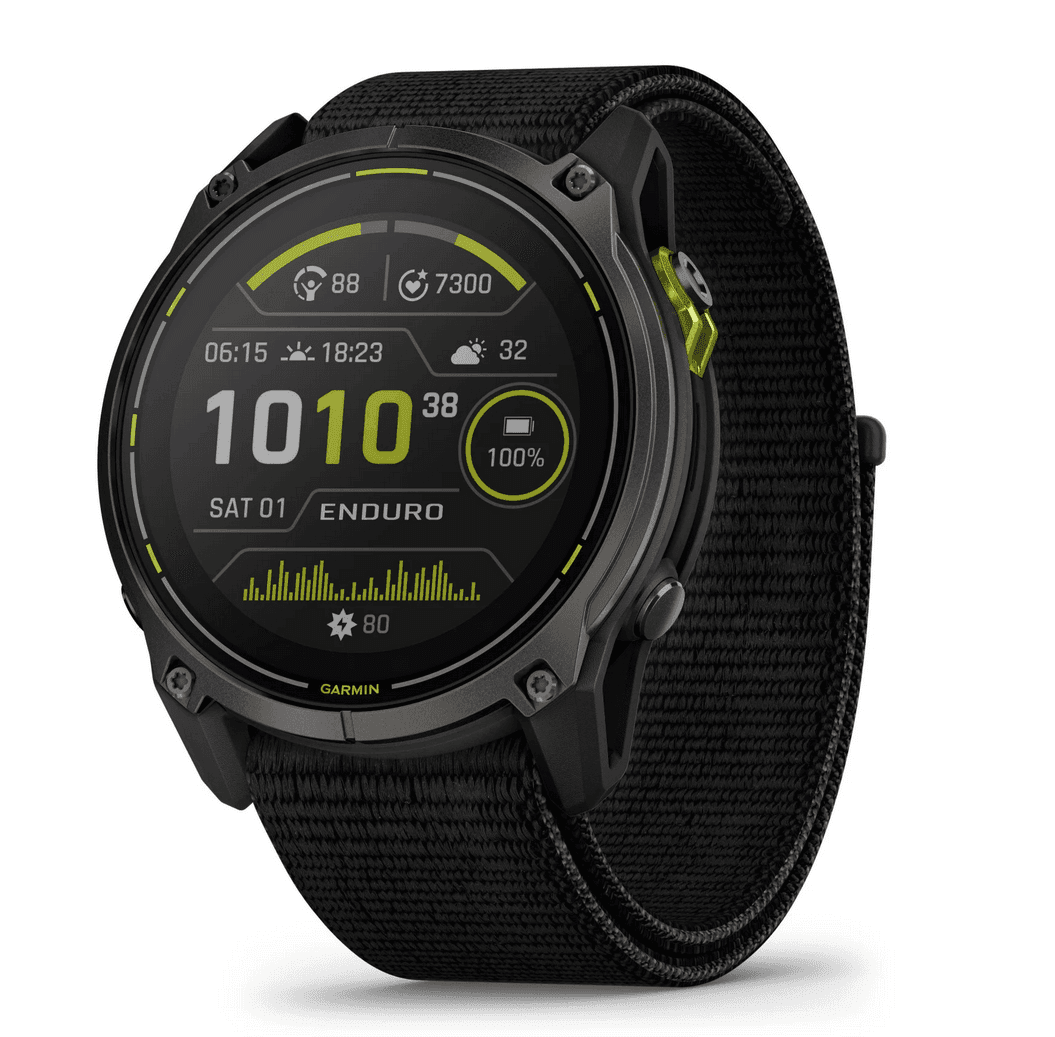
Garmin's Enduro 4 has shown up in Garmin Connect app code, and based on how Garmin typically operates, an August 2026 launch at around $999 looks like the most credible scenario. That puts it squarely in the conversation with the Coros Vertix 3 ($699) and the Polar Grit X2 Pro ($599), though the Enduro line has always pitched itself as the ultra-endurance standard-bearer rather than a budget option. If the price holds, Garmin is betting that the Enduro 4's feature set justifies a $300 premium over its closest rival.
What the Leak Tells Us About Hardware
App code leaks at Garmin usually surface sensor configurations, device identifiers, and connectivity flags before anything else. The Enduro 3 shipped with Garmin's Elevate Gen 5 optical PPG sensor on the wrist, a barometric altimeter for elevation tracking via air pressure, and multi-band GPS pulling from GPS, GLONASS, Galileo, and BeiDou simultaneously. Expect the Enduro 4 to iterate on all three. The Gen 5 PPG sensor was already strong for wrist-based heart rate during steady-state efforts like long trail runs and cycling, though it struggled against a chest strap in high-cadence intervals. If Garmin upgrades to a Gen 6 optical array, that gap could close. For serious interval work, pairing with a Garmin HRM-Pro Plus chest strap (which reads electrical impulses via ECG-style electrodes, not light) remains the cleaner approach regardless.
Battery life is the core value proposition of the Enduro line. The Enduro 3 delivered roughly 90 hours in GPS mode and up to 320 hours in expedition mode with satellite tracking heavily reduced. The Enduro 4 will need to push those numbers meaningfully to justify the upgrade, especially as Coros has been aggressive here. The Vertix 3 already claims 118 hours in full GPS mode. Garmin needs a credible answer, likely through a combination of a larger cell and software-level power management improvements tied to [Connect IQ 9](/en/articles/garmin-connect-iq-9-six-new-capabilities-explained-for-athletes-2026-06-26).
Sensor Stack and Training Features
Beyond GPS and heart rate, the Enduro 4 will almost certainly carry SpO2 monitoring via pulse oximetry (optical, like all wrist-based blood oxygen tracking), skin temperature sensing, and Garmin's HRV Status metric for recovery. That last one competes directly with Whoop 5.0's strain and recovery model, though Garmin integrates the data differently. Whoop gives you a daily recovery score built on HRV, resting HR, and sleep; Garmin spreads similar inputs across HRV Status, Body Battery, and Training Readiness as separate widgets. Athletes who want a single recovery number often find Whoop's approach cleaner. Athletes who want granular control over training load tend to prefer Garmin's ecosystem.
Running dynamics will carry over from the Enduro 3, including ground contact time, vertical oscillation, stride length, and vertical ratio. These metrics still require either the HRM-Pro Plus chest strap or Garmin's Running Dynamics Pod clipped to a shoe to function properly. The wrist sensor alone cannot produce them. For triathletes and Hyrox athletes adding swim segments, the Enduro 4 will need to maintain the open-water swim profiles and pool length detection the Enduro 3 handled competently. Garmin's swim tracking has been class-leading since the Fenix 7 era, and there is no indication that changes here. If you want deeper detail on how Garmin's current platform is evolving, the [Darefore Run BLE running dynamics story](/en/articles/darefore-run-how-a-belgian-dev-cracked-garmin-s-ble-running-dynamics-protocol-2026-06-25) gives useful context on the underlying protocols.
Navigation and Software Ecosystem
The Enduro line's navigation credentials have always been a selling point for trail runners and cyclists doing multi-day events. The Enduro 3 offered full topographic maps, turn-by-turn routing, and ClimbPro for gradient planning on climbs. The Enduro 4 will almost certainly maintain all of this, and Garmin's mapping library remains broader than Coros or Polar's. Coros has been closing the gap, particularly with its [AllTrails integration](/en/articles/coros-alltrails-integration-reviewed-functional-but-behind-garmin-2026-07-03), but Garmin's native map rendering and course management tools are still the benchmark at this price point.
One area worth watching is firmware stability at launch. Garmin has had a mixed 2026 on that front, with multiple watches shipping updates that introduced GPS and HR logging issues. Our [July 2026 firmware bug tracker](/en/articles/garmin-wahoo-suunto-coros-firmware-bugs-july-2026-tracker-2026-07-03) has the details, and it is worth checking before committing to a day-one purchase of the Enduro 4. Garmin typically irons things out within 60 to 90 days, but for a $999 watch, that is a real consideration.
What is likely missing or disappointing at this price: no indication of on-device ECG (true single-lead electrocardiogram, as Apple Watch Series 10 and some Polar models offer), no confirmed upgrade to a higher-resolution display, and the $999 price point still does not include a chest strap in the box. The Enduro 4 will also almost certainly run Garmin OS rather than a fully open platform, which means third-party app options remain limited compared to Apple Watch Ultra 2, even if Connect IQ 9 has added meaningful new capabilities.
The Garmin Enduro 4 at $999 is aimed at one athlete: the ultra-distance trail runner or long-course triathlete who lives in the Garmin ecosystem and needs 90-plus hours of GPS runtime in a watch that also handles daily training metrics without compromise. If that is you and you are currently on an Enduro 2 or older Fenix 7, the upgrade case is real. If you are on an Enduro 3, wait for the full spec sheet before pulling the trigger. Coros Vertix 3 at $699 is the honest comparison point for anyone who wants similar battery life at a lower cost and is less invested in Garmin's platform.
Mentioned watches
Head-to-head comparisons
Buying guides