Garmin CIRQA: Specs, Price, and Bicep Wear Explained
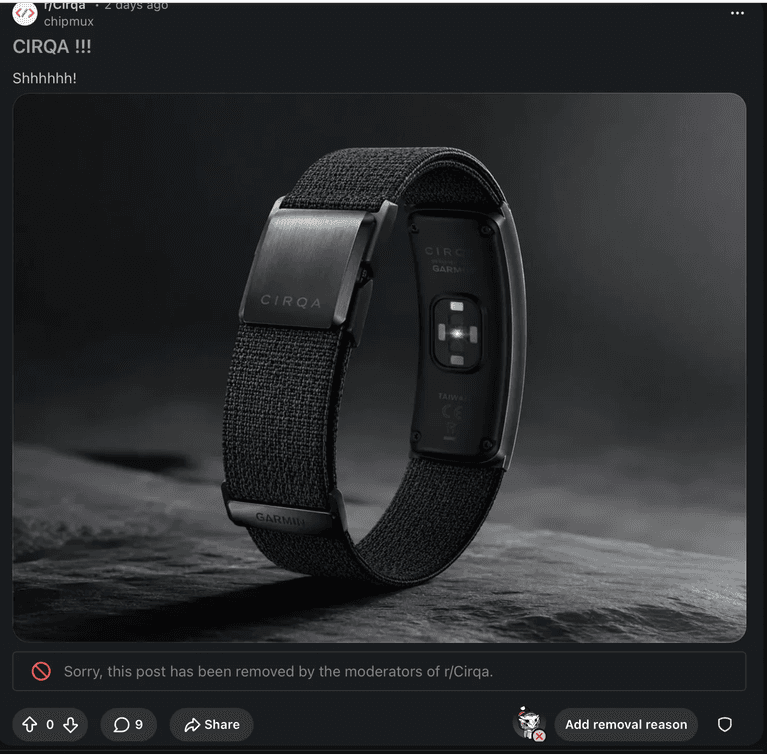
Garmin's CIRQA is a screenless fitness band priced at $199, and it is the most complete picture of an unannounced-then-launched Garmin product in recent memory. Six months of app code analysis, backend queries, and trademark filings gave the community an unusually accurate preview before launch day. The short version: it is a recovery-focused wearable that sits directly in Whoop 5.0 territory, undercuts it on price, and brings Garmin's ecosystem depth as its main weapon.
Sensors and Hardware
The CIRQA uses optical PPG sensors to read heart rate and heart rate variability, which means it measures blood volume changes via light at the skin surface. SpO2 is also optical, as it always is on wrist and arm-worn devices. There is a barometric altimeter for elevation via air pressure, and ANT+ broadcasting is confirmed, which matters for cyclists pairing to a head unit without pulling out a phone. What it does not have is a built-in GPS chip, so run and ride routes depend on a connected phone or a paired Garmin watch. That is the same trade-off you accept with Whoop 5.0 and the Polar Verity Sense.
Battery life figures have not been officially confirmed in the sources available, but the screenless form factor typically allows for multi-week endurance in this category. Whoop 5.0 targets 14 days. Coros's screenless companion band concept never shipped at scale. At $199, the CIRQA is $30 cheaper than a Whoop 5.0 subscription pays for itself in the first year, and it carries no subscription fee beyond what you already pay for Garmin Connect Plus.
Bicep Wear and Accuracy
The detail that separates the CIRQA from most competitors is confirmed upper arm placement support. You set the wear position per activity inside Garmin Connect, so the device knows whether it is on your wrist or your bicep and adjusts its optical PPG algorithms accordingly. Upper arm placement reduces motion artifact during high-intensity work, which is the core accuracy problem for wrist optical sensors during CrossFit, Hyrox, or heavy lifting. Whoop has supported upper arm wear via its bicep band accessory for years, and Polar's Verity Sense was built around that placement from the start. Garmin is not first here, but integrating the position setting into Connect rather than leaving it to guesswork is a clean implementation. For triathletes, the bicep position also keeps the module clear of a wetsuit cuff and away from the wrist where a watch already sits. You can run the CIRQA on your upper arm and your Forerunner or Fenix on your wrist simultaneously, broadcasting optical heart rate to the watch via ANT+ while the watch handles GPS. That pairing makes real sense for open-water swim exits and T1 transitions where wrist clutter is a problem.
Connect Plus Integration and the Whoop Comparison
The CIRQA feeds into Garmin Connect's recovery metrics: body battery, HRV status, sleep staging, and respiration rate. If you already own a Garmin watch, those metrics consolidate in one app across two devices. That is the ecosystem play. Whoop runs its own closed platform with strain scores, recovery percentages, and a journal feature that correlates lifestyle inputs with recovery outputs. Whoop's algorithm is more mature and its community features are stronger. The CIRQA will not replicate that. What it does is close the gap for Garmin users who want 24-hour optical monitoring without wearing a full watch to bed or during contact sport training. Three screenless bands have launched in the past fourteen months and each was positioned as a Whoop killer. None of them is. The CIRQA fits that pattern: it is a Whoop annoyer, not a Whoop killer, because the platform depth, the coaching features, and the social layer that make Whoop sticky are not things a hardware spec sheet can replicate at launch.
For a full head-to-head breakdown of real-world accuracy numbers and recovery metric comparisons, see our [Garmin CIRQA Review: $199 Screenless Band vs Whoop 5.0](/en/articles/garmin-cirqa-review-199-screenless-band-vs-whoop-5-0-2026-08-06).
What Is Missing
No built-in GPS is the obvious gap, and it will frustrate runners who want a single device. There is no screen at all, so glancing at your heart rate zone mid-interval is not possible without a paired watch or phone. The button layout controls basic functions but the CIRQA is not a standalone training computer. Garmin Connect Plus is required to unlock the full metric suite, which adds a recurring cost that the marketing does not always make obvious upfront. Firmware maturity is also an open question at launch. Garmin has had optical accuracy and software issues on new hardware before, and screenless devices with complex multi-position algorithms are not immune. Worth watching the first few firmware cycles before drawing final accuracy conclusions. Our [Garmin and Suunto Firmware Bugs: July 2026 Tracker](/en/articles/garmin-and-suunto-firmware-bugs-july-2026-tracker-2026-08-07) has context on how Garmin handles post-launch patches.
The CIRQA makes the most sense for three types of athletes: Garmin watch owners who want continuous optical monitoring without sleeping in a full watch, triathletes who need a discrete upper-arm sensor during swimming or contact-sport training, and CrossFit or Hyrox athletes who want wrist-free heart rate with ANT+ broadcast to a gym display. At $199 with no mandatory subscription, it is cheaper long-term than Whoop 5.0 and better ecosystem-integrated than the Polar Verity Sense for anyone already in Garmin Connect. If you are not in the Garmin ecosystem and you want the best recovery platform available, Whoop 5.0 is still the more complete product. Buy the CIRQA for the hardware flexibility and the price. Buy Whoop for the platform.
Mentioned watches
Head-to-head comparisons