Garmin CIRQA Review: $199 Screenless Band vs Whoop 5.0
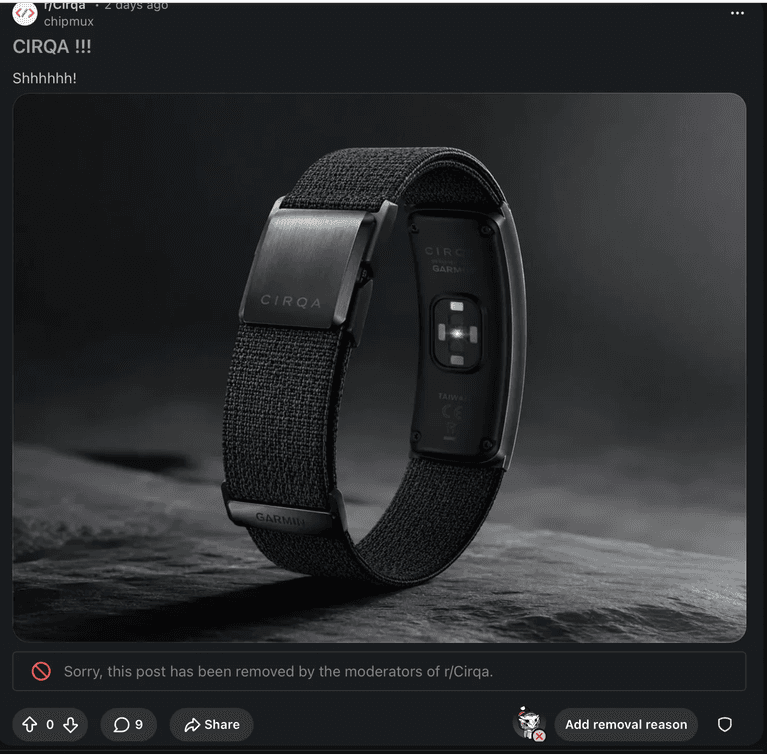
Garmin's CIRQA is a screenless recovery band priced at $199, and it lands in a market where Whoop charges $239 per year on subscription. That pricing gap is the whole story in one line. The CIRQA is a one-time purchase with no mandatory membership, and that alone will move units among endurance athletes who are tired of recurring fees.
Sensors and Hardware
The sensor stack runs on Garmin's Elevate Gen 4.1 optical PPG module, which reads heart rate and heart rate variability via light-based blood volume detection at the wrist or upper arm. Skin temperature and SpO2 round out the hardware, both confirmed via a Romanian Garmin support page listing before it was pulled. SpO2 is optical, same as every other wrist-based blood oxygen reading on the market, so the usual ambient light and fit caveats apply. What's interesting is that Garmin chose Gen 4.1 over the newer Gen 5 sensor already found in the Fenix 8 and Epix Pro series. That's a deliberate cost and battery trade-off, not an oversight, and it does place the CIRQA below Garmin's top optical hardware in the hierarchy.
The CIRQA also confirms upper arm wear, configurable per activity inside Garmin Connect. Bicep placement is a real accuracy win during high-intensity efforts like CrossFit or Hyrox, where wrist movement creates optical noise. It also protects the module during contact work. If you've ever worn a Polar OH1 on your upper arm and compared it to wrist data during a 400m repeat, you already know how much cleaner the signal gets. The CIRQA builds that optionality directly into the platform rather than requiring a separate sensor.
Performance Compared to Whoop and Polar
Whoop 5.0 uses its own PPG sensor array plus skin temperature and SpO2, broadcasting into a proprietary ecosystem built around strain, recovery, and sleep scores. The CIRQA plugs into Garmin Connect, which means your recovery data sits alongside your Garmin GPS watches, structured workouts, and training load metrics. For a triathlete already running a Forerunner 965 or Fenix 8, that ecosystem integration is worth real money. You're not juggling two apps. Polar's Ignite 3 sits near the same price point but includes a screen and lacks the bicep wear option. Coros doesn't have a screenless band in this category yet.
HRV accuracy on Gen 4.1 hardware is solid for resting overnight reads but degrades faster than chest ECG straps during elevated heart rates. A Garmin HRM-Pro strap reads electrical impulses directly and will always be more precise for live HRV during intervals. The CIRQA is not meant for that. It's designed for passive overnight and all-day monitoring, which is exactly where optical sensors perform best and where Whoop has built its reputation.
Real-World Use Cases
For a Hyrox athlete or CrossFitter, the upper arm wear during training is the standout feature. You get cleaner PPG data, and the band doesn't interfere with wrist-based barbell work. For triathletes, the swim compatibility matters. The band is rated for water, though like any optical sensor submerged in a pool, SpO2 is not functional underwater. Heart rate during open water swimming from the wrist is generally unreliable with optical sensors regardless of brand. Upper arm placement helps here too, and the ANT+ broadcast capability means you can pair it to a bike computer or GPS watch as an external heart rate source mid-training.
Recovery tracking is where the daily use case lives. Skin temperature trends over multiple nights are one of the more underrated early warning signals for overtraining or incoming illness. Garmin has been building this into Body Battery and HRV Status on its watch lineup for two years. The CIRQA brings that same data layer to athletes who don't want a watch on their wrist 24/7, which is a real segment. You can read more about the full confirmed spec sheet in our [Garmin CIRQA at $199: Specs, Sensors, and Who Should Buy It](/en/articles/garmin-cirqa-at-199-specs-sensors-and-who-should-buy-it-2026-07-29) piece.
What's Missing
The Gen 4.1 sensor choice is the main disappointment. Gen 5 brings improved HRV accuracy and better motion artifact rejection, both relevant for a recovery band worn during sleep and daily movement. Choosing the older hardware keeps cost down but puts a ceiling on data quality that power users will notice when comparing overnight HRV consistency to a Whoop 5.0 or an Apple Watch Series 10 running its sleep tracking algorithm. There's also no standalone GPS, which is expected for this form factor, but no display at all means zero real-time feedback during training unless you're paired to a watch or head unit. For some athletes that's fine. For others it's a dealbreaker.
The CIRQA is the right product for the Garmin athlete who wants passive recovery tracking without a second ecosystem. At $199 one-time versus $239 per year for Whoop, the value math is obvious for anyone not already invested in Whoop's strain coaching features. If you're running a Fenix 8 or Forerunner 965 and want seamless recovery data in Connect, buy the CIRQA. If you're not in the Garmin ecosystem and want the most sophisticated recovery coaching available, Whoop 5.0 still holds that ground.
Mentioned watches
Head-to-head comparisons
Buying guides