Used Chinese EV Imports Face European Ownership Costs
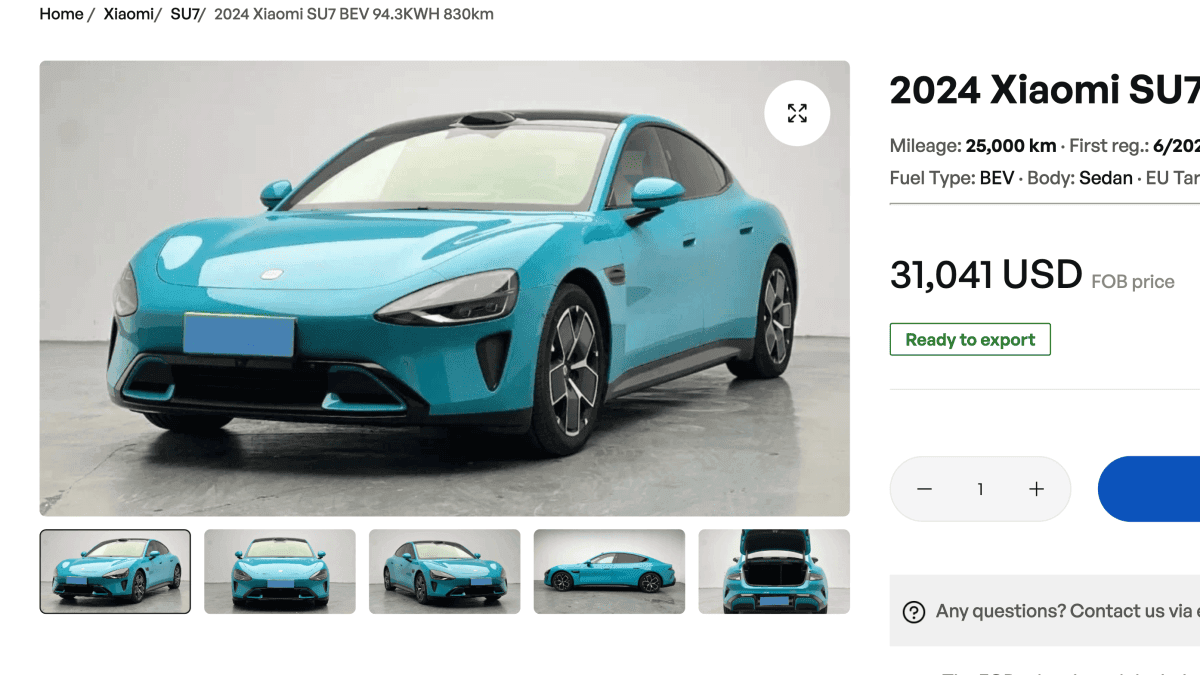
Used Chinese electric-car imports are gaining traction in Europe, but the headline discount can vanish before the car reaches a French driveway. China EV Marketplace says its used-vehicle sales to European customers rose 280% year on year to 7,900 units between January and September 2026, while its new-car sales fell 44%. For athletes who already follow Xiaomi’s hardware closely, that makes a Xiaomi SU7 or YU7 tempting in the same way an early new wearable can be tempting. The ownership calculation is far less tidy.
The used-car loophole is real
The EU’s countervailing duties introduced on October 30, 2024 apply to new China-built EVs, on top of the usual 10% customs duty. According to Frandroid, a vehicle with more than 6,000 km pays only that 10% base duty. China EV Marketplace has built its European offer around that distinction, listing more than 2,600 used cars sourced by a Shanghai team. Its operations director says cars with 6,000 km can regularly be listed at 40% below their Chinese catalogue price.
That 40% is the starting price, not the ownership price. Frandroid’s October 2026 simulation puts a 2024 Xiaomi SU7 Pro with 25,000 km at an estimated €44,200 in France, after shipping, customs duty, clearance, individual approval in the Czech Republic, delivery, VAT and a charging adapter. That is 42% above its new price in China. A Xpeng Mona M03 620 with 12,000 km reaches an estimated €27,500, while a Xiaomi SU7 Ultra with 30,000 km reaches €65,900, only 2% below its new Chinese price.
The practical compromise starts at the charger
The most immediate issue is the Chinese GB/T charging port, which does not match the CCS standard used at European rapid chargers. Frandroid says an active adapter is essential and costs several hundred euros, while often capping charging around 100 kW or less. It also warns that communication between car and charging station can fail. A second adapter is needed for home charging. For an endurance athlete used to charging a watch, bike computer and lights before a dawn session, this is exactly the sort of small logistical friction that becomes tiresome over time.
Software and support matter just as much. Chinese-market cars retain Chinese-oriented interfaces and voice assistants, incomplete translations, mapping of limited use in Europe, no native CarPlay or Android Auto, and uncertain over-the-air updates outside China, Frandroid reports. That is a sharp contrast with the expectation set by Xiaomi’s expanding device ecosystem, including its [Watch 5 with an EMG sensor](/en/articles/xiaomi-watch-5-adds-emg-sensor-before-garmin-and-apple-2026-05-16). Familiar branding does not mean a shared, polished European support experience.
Service, insurance and resale are the weak points
What is missing is a dependable local safety net. The manufacturer warranty exists on paper but goes through the platform, with the customer paying to send parts and facing one to three weeks of logistics. Wear items may be obtainable, but body panels can leave a car immobilised for weeks. The platform announced a European after-sales network for the first quarter of 2026, so buyers should ask which workshops are actually available nearby. Insurance also needs a firm quote using the vehicle identification number before payment, since a Chinese-spec car never sold in France may have no SRA classification reference.
Our verdict: importing can make sense for someone determined to own a YU7 before its official arrival, or for a rare model unavailable locally. For most buyers, it is a high-effort bet against waiting for an official European launch, with CCS charging, clearer warranty support and a less fragile resale story.
Mentioned watches