Fitbit Air vs Whoop MG HR Accuracy: HYROX and HRV Test Results
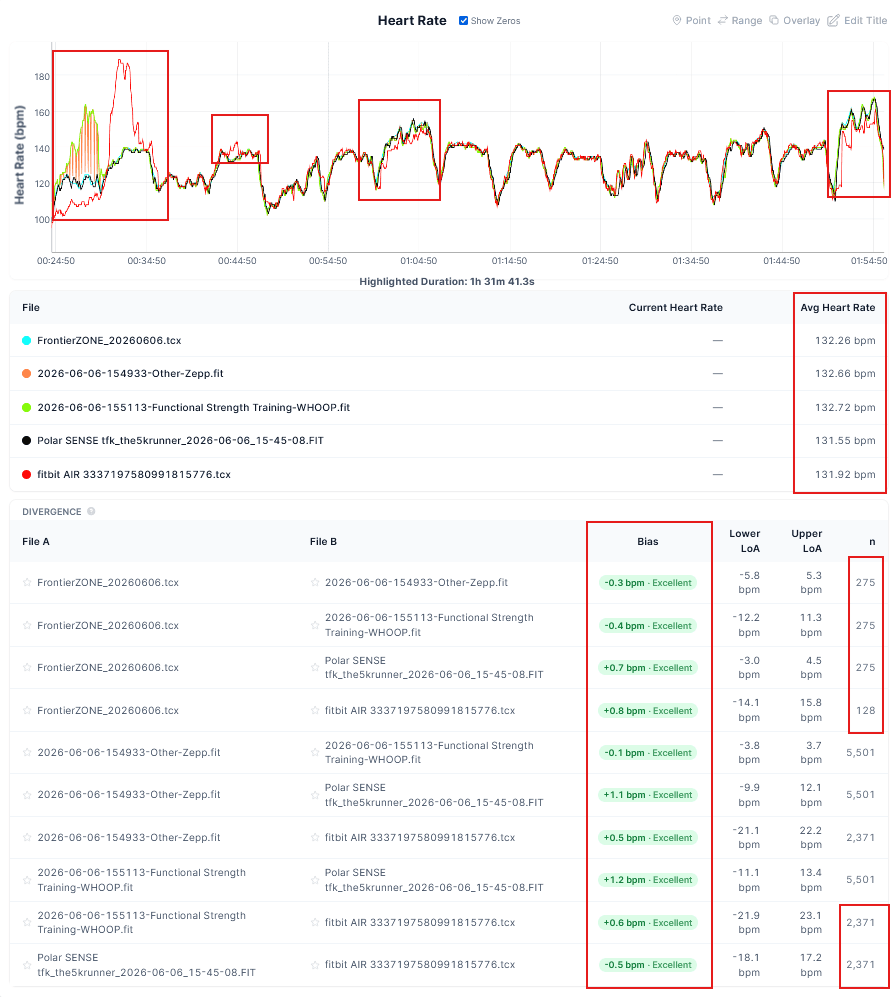
Whoop MG worn on the biceps matched a chest-strap ECG to within ±2.5 bpm across a five-device HYROX simulation test. Fitbit Air, by contrast, produced the widest error range of any device on test. Those two sentences tell most of the story, but the details matter if you're deciding where to spend your money in 2026.
Sensor Setup and What Was Actually Measured
A chest strap reads electrical impulses from the heart muscle directly through the skin. That's ECG. The wrist and biceps devices here, including the Fitbit Air and Whoop MG, use PPG optical sensors that shine light into tissue and measure changes in blood volume. Neither approach is inherently wrong, but placement, skin contact pressure, and movement artifact all affect PPG accuracy in ways that ECG is largely immune to. Three reference methods were used across the test: a chest-strap ECG reference, plus two additional comparison points, covering both heart rate and HRV capture. Five devices total were evaluated, giving enough spread to identify outliers clearly.
Fitbit Air's core problem in this test wasn't just raw HR error during steady effort. It locked on late at the start of intervals and generated false interval readings, which is a separate failure mode from simple magnitude error. For HYROX specifically, where you're swinging from sled pushes to ski ergs to burpee broad jumps within a single workout, a sensor that lags the onset of intensity spikes is practically useless for real-time pacing. The Amazfit Cheetah 2 Ultra performed close to the Whoop MG on accuracy in the same HYROX simulation, which is worth noting given its significantly lower price point. You can see its standalone GPS and HR numbers in our [Amazfit Cheetah 2 Ultra accuracy breakdown](/en/articles/amazfit-cheetah-2-ultra-gps-and-heart-rate-accuracy-real-numbers-2026-06-18).
HRV Capture: Where watchOS 27 Also Falls Short
The HRV picture is nearly as problematic as the HR picture, just for different devices. watchOS 27 records HRV for only 4 minutes per hour, which is a structural limitation baked into the platform rather than a hardware failure. That's a meaningful constraint compared to Whoop's continuous overnight HRV tracking or Garmin's full-night HRV status, both of which aggregate far more data points before generating a recovery score. Polar's H10 chest strap remains the field reference for HRV capture and costs around $100, which puts the software-side failures here in awkward context.
Fitbit Air's HRV issues compound the HR problems. False interval generation means the device is feeding corrupted data into any HRV calculation downstream. If you're using HRV to drive training decisions, a device producing phantom intervals is worse than no HRV data at all, because you trust it. The Google Health 5.0 app, which handles Fitbit Air data, has its own display and workflow issues on top of the sensor problems, as we covered in our [Google Health 5.0 app review](/en/articles/google-health-5-0-app-review-design-flaws-hurt-fitbit-air-data-2026-06-08).
HYROX and Functional Fitness: Real-World Implications
HYROX is a worst-case scenario for wrist optical PPG. You've got static holds, loaded carries, rowing, and wall balls in a single race format. Wrist motion is constant and varied. The Whoop MG's biceps placement partially sidesteps this by moving the sensor away from the wrist joint, reducing motion artifact during grip-heavy movements. That's a practical fit advantage in functional fitness that a Garmin Forerunner 975 or Coros Pace 4 on the wrist simply can't replicate without a companion chest strap.
For pure running and cycling, the gap narrows. Whoop MG's lack of GPS and no display makes it a poor standalone device for those sports without a phone. Garmin and Coros both offer on-wrist GPS accuracy in the 98th percentile for track and road running, and neither has the motion-artifact problem at moderate intensities. Fitbit Air's 2-second optical sampling rate, which we analyzed separately in our [Fitbit Air sampling rate piece](/en/articles/fitbit-air-2-second-sampling-rate-what-it-means-for-sport-2026-06-14), already puts it behind competitors at peak HR detection before you factor in the lock-on lag.
What's missing from both the Fitbit Air and Whoop MG is barometric altimeter integration for elevation-based training load. Both devices lack GPS natively. Whoop MG has no screen and no real-time feedback, which is a deliberate design choice, but it limits its use for interval training where you want splits on your wrist. Fitbit Air has a display and some sport modes, but the accuracy failures documented here undermine the core value proposition for anyone doing structured training.
Fitbit Air is a disappointment for serious endurance athletes and functional fitness competitors at any price. Whoop MG is a strong recovery and HR monitor specifically for HYROX and strength-based athletes who can tolerate the no-display, no-GPS tradeoffs, and its biceps placement is a real accuracy advantage over wrist-worn alternatives in that context. If you want a single wrist device for triathlon or running with reliable HR, a Garmin Forerunner 265 at $450 or a Coros Pace 4 at $250 still outperforms both on breadth. For HYROX-specific HR tracking, Whoop MG paired with any GPS watch wins the accuracy argument here.
Mentioned watches
Head-to-head comparisons
Buying guides