Menstrual Cycle and Endurance Training: What Your Wearable Actually Measures
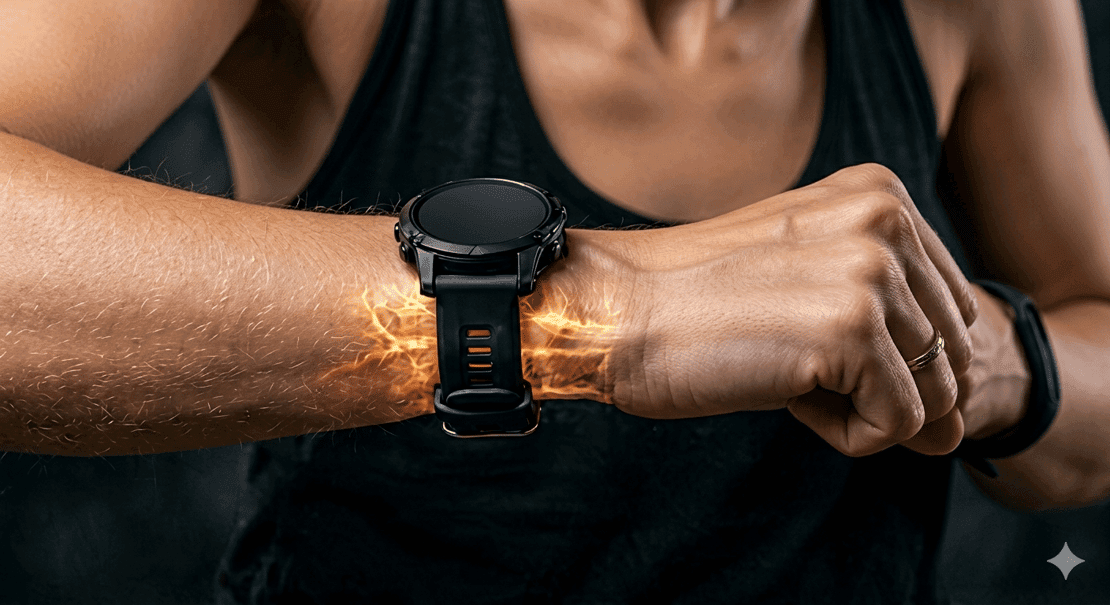
Your hormones are running the show, and your wearable is only half-reading the script. Oestrogen and progesterone shift heart rate, fuel metabolism, core temperature, HRV, and recovery scores across a roughly 28-day cycle. Every endurance athlete who menstruates is training through four distinct physiological environments, and most devices treat all four as identical.
What the Hormones Are Actually Doing
In the follicular phase (days 1 to 14 roughly), rising oestrogen improves insulin sensitivity and pushes your body toward carbohydrate oxidation. Heart rate at a given pace tends to run lower, HRV tends to be higher, and perceived effort drops. Garmin's Body Battery and Whoop's Recovery Score will often look unusually green here, not because you rested better, but because the hormonal environment is genuinely more favourable for output. Polar's Nightly Recharge uses overnight HRV and autonomic nervous system data measured via optical PPG at the wrist, and it will pick this up, but it won't tell you why.
Ovulation triggers a brief LH surge. Core temperature rises 0.3 to 0.5 degrees Celsius and stays elevated through the entire luteal phase. That matters directly for heat stress during long runs or cycling in warm conditions. Progesterone dominates the luteal phase (days 15 to 28), shifting fuel use toward fat oxidation, raising resting heart rate by 2 to 5 bpm, and suppressing HRV. Your Garmin Forerunner or Coros Pace will flag higher training load and lower recovery readiness during this window. The numbers aren't wrong. The context is just missing.
What Your Wearable Can and Cannot Detect
Wrist optical sensors read blood volume changes via PPG light. That gives you heart rate, HRV, SpO2, and skin temperature. None of those sensors measure hormones directly. What they catch are downstream effects: the elevated resting HR, the suppressed HRV, the fractionally higher skin temperature in the luteal phase. The Garmin Venu 3 and Apple Watch Series 10 both include skin temperature tracking now, and a consistent 0.3 to 0.5 degree shift across your luteal phase is detectable if you build a personal baseline over two or three cycles. Whoop 5.0 does the same and folds it into cycle context if you log your period in the app.
Chest straps like the Polar H10 or the [Amazfit Helio Strap Pro](/en/articles/amazfit-helio-strap-pro-hands-on-review-for-endurance-athletes-2026-06-21) read electrical impulses directly from cardiac muscle, giving you cleaner HRV data than any wrist PPG. That precision matters here: the HRV suppression in the luteal phase is real but subtle, often just 5 to 12 ms lower rmsSD than your follicular baseline. A Polar H10 paired to HRV4Training will catch that shift more reliably than a wrist sensor during sleep. Coros and Garmin both use wrist PPG overnight, which is convenient but noisier.
Practical Implications for Training and Recovery
For runners targeting key workouts, the late follicular phase is your performance window. Lactate threshold work, VO2max intervals, race-effort long runs: schedule them here. [Garmin's 2025 data confirmed that training volume predicts VO2max gains](/en/articles/garmin-2025-data-training-volume-is-the-top-vo2max-predictor-2026-06-13), but volume absorbed at a lower physiological cost in the follicular phase compounds differently than the same volume in the luteal phase. You are not imagining that Tuesday's 10K effort felt harder three weeks later at the same pace.
For cyclists and triathletes, the elevated core temperature in the luteal phase shortens your heat stress buffer. A 35-degree ride in week three of your cycle carries meaningfully more cardiovascular strain than the same ride in week one. Power-to-heart-rate ratio will drop. Your Garmin or Coros will read that as reduced aerobic efficiency. It is not a fitness regression. The baro altimeter in your watch is reading air pressure to track elevation, and it knows nothing about your hormones, but the HRV and HR data it collects are telling the real story if you know how to read it.
For CrossFit and Hyrox athletes, progesterone's effect on ligament laxity in the late follicular and ovulatory phases is well-documented. Injury risk at joints, particularly knees and ankles, rises slightly around ovulation. This is not a reason to stop training. It is a reason to be precise with landing mechanics and loading during that window. Your wearable will not flag this at all.
What is missing is frustrating. No mainstream watch in 2026 integrates cycle phase into training load recommendations automatically without manual logging. Whoop comes closest, but its cycle tracking still requires you to manually input period start dates and relies on historical patterns rather than real-time hormonal data. Garmin's cycle tracking feature logs symptoms and predictions but does not yet feed phase data into Training Readiness or Body Battery calculations in a meaningful way. [WatchOS 27 added several health tracking improvements](/en/articles/watchos-27-sport-and-health-features-everything-endurance-athletes-need-to-know-2026-06-19), but Apple Watch still treats hormonal context as a standalone health app feature, disconnected from workout load metrics. The gap between what the sensors could infer and what the software actually uses remains wide.
Bottom line: if you are a female endurance athlete, the Whoop 5.0 at around 359 dollars per year or the Garmin Forerunner 965 at 599 dollars give you the best current tools for tracking cycle-linked HRV and temperature shifts. Whoop edges ahead on recovery context. Garmin wins on training load depth and GPS accuracy. Neither replaces the practice of manually logging your cycle and building a personal two to three cycle baseline. The sensors are capable enough. The software just has not caught up yet.
Mentioned watches
Head-to-head comparisons
Buying guides