Fitbit AIR vs watchOS 27 HRV Accuracy: Five Devices Tested
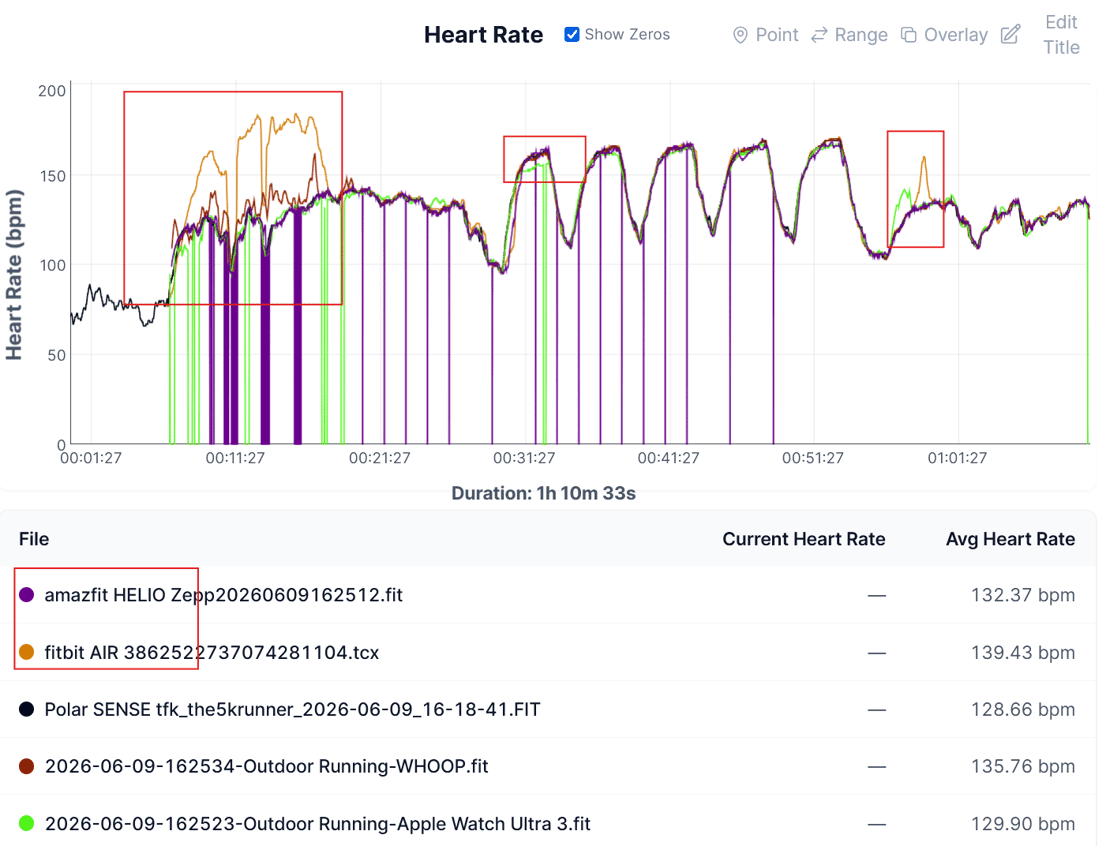
Five devices, three reference methods, one chest strap as the ground truth. That is the setup from The5kRunner's latest accuracy test, and the results are worth unpacking if you care about heart rate and HRV reliability during training and recovery. The field included Fitbit AIR, an Apple Watch running watchOS 27, and WHOOP MG worn on the bicep, among others. Spoiler: placement matters more than brand.
HRV Recording: Where watchOS 27 and Fitbit AIR Fall Short
watchOS 27 records HRV for just 4 minutes per hour. That is not a typo. For a metric that requires stable, extended readings to be meaningful, four minutes of optical PPG data per hour is thin. Polar's Nightly Recharge uses the full first five hours of sleep, and WHOOP samples continuously through the night, which is why those platforms tend to produce more stable RMSSD trends over weeks. Four minutes can catch a snapshot, but one restless turn or a single ectopic beat can skew the number significantly. For serious endurance athletes tracking recovery load across a training block, that sampling window is a real limitation.
Fitbit AIR has a different problem. It locks on late to HRV intervals and generates false readings in the process. In practice, this means the opening minutes of a measurement session are unreliable, and the device can produce inflated or suppressed HRV scores depending on where in the night the lock-on delay occurs. Garmin's Body Battery and Coros's recovery metrics both rely on overnight HRV sampling too, but neither has shown the same systematic lock-on lag in recent independent testing. Fitbit AIR's optical sensor is doing PPG-based pulse interval detection, not electrical measurement like a chest strap, and any movement artifact or perfusion issue during lock-on compounds the error. The result is HRV data you cannot fully trust without cross-referencing.
WHOOP MG Bicep Placement: The Accuracy Story
The standout result in this test is the WHOOP MG worn on the bicep, which matched a chest strap ECG reference to within plus or minus 2.5 bpm during the measured sessions. Chest straps read electrical impulses from the heart directly, making them the closest non-clinical reference available to endurance athletes. The WHOOP MG uses optical PPG, detecting changes in blood volume through the skin using light, so a 2.5 bpm margin against an ECG-based strap is a strong result. For context, Garmin's Elevate v5 sensor on the Forerunner 975 typically lands within plus or minus 3 to 5 bpm during steady-state running, and wrist optical sensors from Polar and Coros sit in a similar range. Bicep placement reduces motion artifact compared to the wrist, which explains part of the WHOOP MG's edge here. Less tendon movement, more consistent skin contact, better signal.
This has direct relevance for athletes doing high-cadence cycling, CrossFit, or Hyrox workouts where wrist movement is constant and optical sensors struggle to filter noise. If you have already looked at the [Fitbit Air vs Whoop MG HR accuracy test covering Hyrox conditions](/en/articles/fitbit-air-vs-whoop-mg-hr-accuracy-hyrox-and-hrv-test-results-2026-06-21), the bicep result there aligns with what this multi-device test found. Placement is a repeatable variable, not a fluke.
Practical Implications for Endurance Athletes
For runners and cyclists whose training depends on accurate real-time HR zones, the gap between a well-placed optical sensor and a chest strap is manageable at steady pace. The problems stack up during interval work, transitions in triathlon, or any session where your heart rate is moving fast and the optical sensor is fighting motion artifact. Fitbit AIR's late lock-on makes it particularly unreliable for interval HRV analysis post-session, since the early beats of a recovery window are exactly when the measurement should start. watchOS 27's four-minute-per-hour sampling is less of an issue during workouts, where the sensor runs continuously, but it directly limits overnight recovery scoring. If recovery tracking is your priority, that matters.
Swimming is a separate use case worth flagging. Optical sensors on the wrist can perform better in water than in high-movement dryland sports because the medium compresses the device against the skin and reduces artifact. The Amazfit Balance 3 showed this in a recent pool test covering lap accuracy and HR alongside FORM Smart Swim 2 LT goggles. Different product, different test, but the physics are consistent: water pressure helps optical contact. Check the [Amazfit Balance 3 swimming accuracy review](/en/articles/amazfit-balance-3-hyrox-review-hr-accuracy-and-partnership-assessed-2026-06-21) for numbers specific to that platform.
What Is Missing From This Test
The source summary does not break down accuracy figures by heart rate zone, which is the most useful cut for endurance athletes. Knowing a device is within 2.5 bpm on average across a session tells you less than knowing it drifts to 8 bpm error at 175 bpm during a VO2max interval. Garmin and Polar publish zone-specific accuracy claims; independent tests that replicate that breakdown are more actionable. The test also does not include Coros, which has been improving its optical sensor across the Pace 4 and Vertix 3 line, or any dedicated HRV app like HRV4Training that uses the phone camera as a reference. Five devices is a solid sample, but the absence of zone-specific error reporting leaves the headline numbers somewhat abstract for athletes who train by power or pace-HR decoupling.
The WHOOP MG bicep result is the clearest takeaway here, and it reinforces what placement-focused testing has been showing for two years. Fitbit AIR's lock-on issue and watchOS 27's limited HRV window are real limitations, not edge cases. If you rely on overnight HRV for recovery decisions, neither platform currently matches what WHOOP, Polar, or a dedicated Garmin sleep-tracking setup delivers. At around 299 dollars for WHOOP MG with a membership, it is not cheap, but the accuracy data backs the cost for athletes who need reliable HRV trends. Fitbit AIR targets a more casual user at a lower price point, and the accuracy reflects that. watchOS 27 on an Apple Watch Ultra 3 costs significantly more and should do better on HRV sampling given the hardware. Four minutes per hour is a software choice, and it is the wrong one for endurance athletes.
Mentioned watches
Head-to-head comparisons
Buying guides