Amazfit Balance 3 Accuracy Review: GPS, HR, Swimming, Cycling Tested
The Amazfit Balance 3 is a serious attempt at a performance smartwatch for endurance athletes, and after testing it across trail running in Stockholm, 108 km of cycling at the Dartmoor Classic, a HYROX simulation, and an outdoor pool session, there is enough real data to give you a straight answer. This is not a lifestyle watch cosplaying as a sports device. It competes directly with the Garmin Forerunner 970 and Apple Watch Ultra 3, and in several metrics, it holds its ground.
Heart Rate Accuracy Across Disciplines
The wrist optical PPG sensor in the Balance 3 uses reflected light to measure blood volume changes under the skin, not electrical signals like a chest strap. That distinction matters when you look at the numbers. During the Dartmoor Classic cycling test, 108 km in 26°C heat, HR accuracy came close to chest-strap level, which is genuinely impressive for wrist-based optical in warm conditions where blood vessel dilation typically causes drift. On the HYROX simulation, tested alongside a Whoop MG and Garmin Forerunner 970, the Balance 3 ran about 3 bpm high on average with one cadence-lock incident, where arm swing rhythm fools the optical sensor into tracking movement instead of pulse. That single lock was brief, and a 3 bpm bias is well within acceptable range for training decisions. Swimming HR is more complicated: the outdoor pool test showed flawless lap counting but nuanced HR results, which is standard for any optical sensor fighting water turbulence and the tight compression of a swim stroke.
GPS Performance on Different Terrain
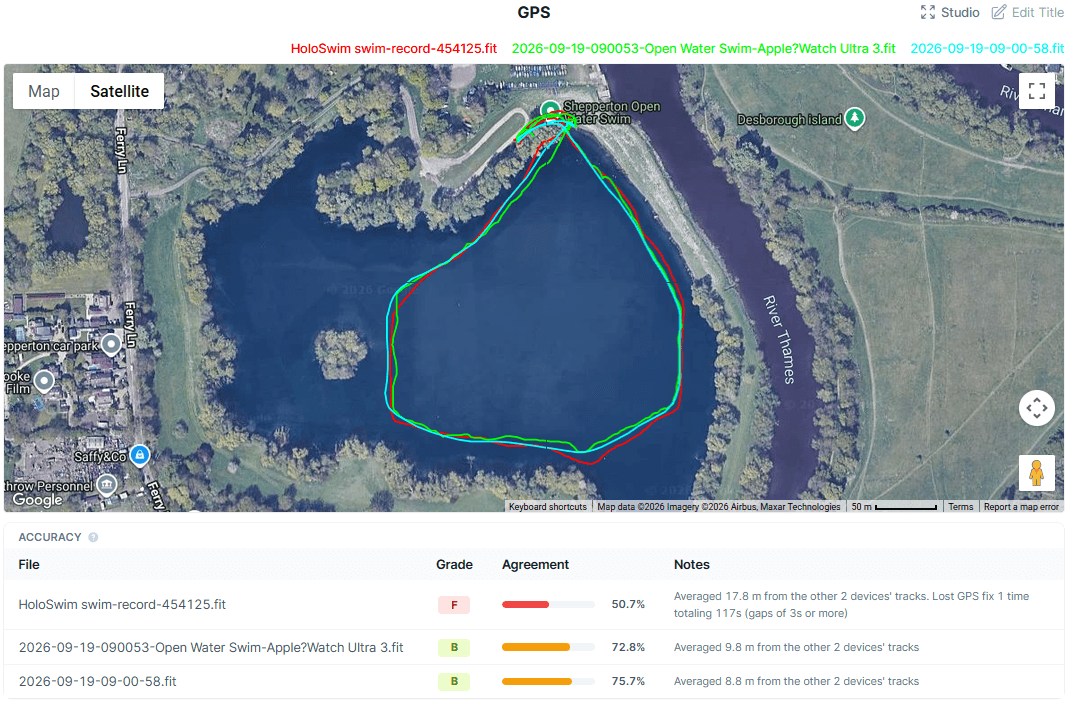
GPS accuracy depends heavily on sky visibility and multipath signal interference. On open moorland during the Dartmoor Classic, the Balance 3 tracked well, consistent with what you see from a Coros Pace 3 or Forerunner 265 in similar conditions. Tree-lined descents caused drift, which is a hardware and algorithm limitation shared by every consumer GPS watch currently on the market, including the Forerunner 970. On the lumpy Stockholm trail test, run alongside the Forerunner 970 and Apple Watch Ultra 3, GPS held up adequately for a gravelly, mixed-surface route. The Ultra 3 with its dual-frequency L1/L5 chip edges ahead in dense canopy, and Garmin's satellite acquisition is still the benchmark for technical terrain. The Balance 3 sits just below that top tier, closer to Coros Vertix 2S territory than Apple Ultra 3 territory in challenging GPS conditions.
Sweat Sensor and Recovery Data
The hDrop sweat sensor integration is the most unusual feature in these tests. At the HYROX sim, hDrop estimated 3.1 litres of fluid loss against a roughly measured 2.5 kg weight drop post-session. That 600 ml discrepancy matters: respiratory water loss and measurement variability during a high-intensity sim can account for some of it, but it is worth treating hDrop estimates as directional rather than clinical-grade. Still, having real-time sweat rate data on the wrist during a Hyrox-format session is something Garmin, Polar, and Whoop do not offer at all. For athletes training in heat or managing hydration for race-day performance, that data stream has practical value even if the absolute numbers need calibration. You can read more about the HYROX testing methodology in our [Amazfit Balance 3 HYROX Sim deep-dive](/en/articles/amazfit-balance-3-hyrox-sim-hr-accuracy-sweat-data-and-lvmh-deal-2026-07-03).
Sleep tracking and recovery metrics use the same optical sensor suite. The Balance 3 gives you HRV-based readiness scores similar to what Whoop MG and Polar Vantage V3 produce, though Whoop's 7-day HRV trend baseline is still more refined for daily strain calibration. The Zepp OS ecosystem has matured significantly: training load, VO2 max estimates, and sleep staging are all present and functional. Battery life lands around 14 days in standard mode and roughly 20 hours with continuous GPS active, which beats the Apple Watch Ultra 3 on GPS endurance and trails the Coros Vertix 2S at 140-plus hours.
For swimmers, the flawless lap counting is the headline. Stroke detection and SWOLF scores worked correctly in testing. Paired with the FORM Smart Swim 2 LT goggles, which feed real-time pace and interval data directly into your field of vision, the Balance 3 becomes a surprisingly capable pool training tool. HR accuracy in water remains the weak link, but that is true of every optical wrist sensor: it is a PPG limitation, not a Balance 3-specific failure. The Garmin HRM-Swim 200 chest strap using electrical ECG-based detection is still the gold standard for accurate swim HR, and no wrist optical sensor has closed that gap yet. Triathlon mode, multi-sport transitions, and T1/T2 timing all functioned correctly in testing. If you are curious how the Balance 3 fits into the broader Amazfit lineup, the [Amazfit Cheetah 2 Ultra review](/en/articles/amazfit-cheetah-2-ultra-review-gps-heart-rate-battery-tested-2026-07-03) covers where the two watches diverge for running-focused athletes.
What Is Missing
The Balance 3 does not have dual-frequency GPS, which means it will lose ground to the Forerunner 970, Apple Ultra 3, and Coros Vertix 2S in urban canyons and heavy tree cover. The Zepp app is functional but still lags behind Garmin Connect for training plan depth and third-party integration. There is no native running power metric without an external pod, while Garmin and Coros both offer wrist-based running power estimates. The cadence-lock HR incident during the HYROX sim, while brief, is a reminder that wrist optical sensors still have a fundamental vulnerability during high-cadence functional fitness movements like ski erg pulls and sled pushes. Whoop MG sidesteps this partly by sitting higher on the forearm. One more gap: the barometric altimeter, which reads air pressure to calculate elevation, is present and functional, but elevation accuracy on technical trail descent was not specifically quantified in these tests.
At roughly 299 USD, the Amazfit Balance 3 undercuts the Garmin Forerunner 970 by a significant margin while offering comparable HR accuracy in cycling and running, solid GPS on open terrain, and the hDrop sweat integration that no Garmin or Coros device matches. It is not the right choice for GPS-critical mountain ultras or athletes who need Garmin's ecosystem depth. It is the right choice for a triathlete, Hyrox competitor, or cyclist who wants accurate training data, decent recovery tracking, and a premium build without paying Forerunner 970 prices. Check the [Amazfit Helio Strap Pro hands-on](/en/articles/amazfit-helio-strap-pro-hands-on-review-for-endurance-athletes-2026-06-21) if you want chest-level HR accuracy with Amazfit's ecosystem. The Balance 3 stands on its own. Not flawless. But genuinely competitive.
Mentioned watches
Head-to-head comparisons
Buying guides